Recap: Chapter 1 , Part 1
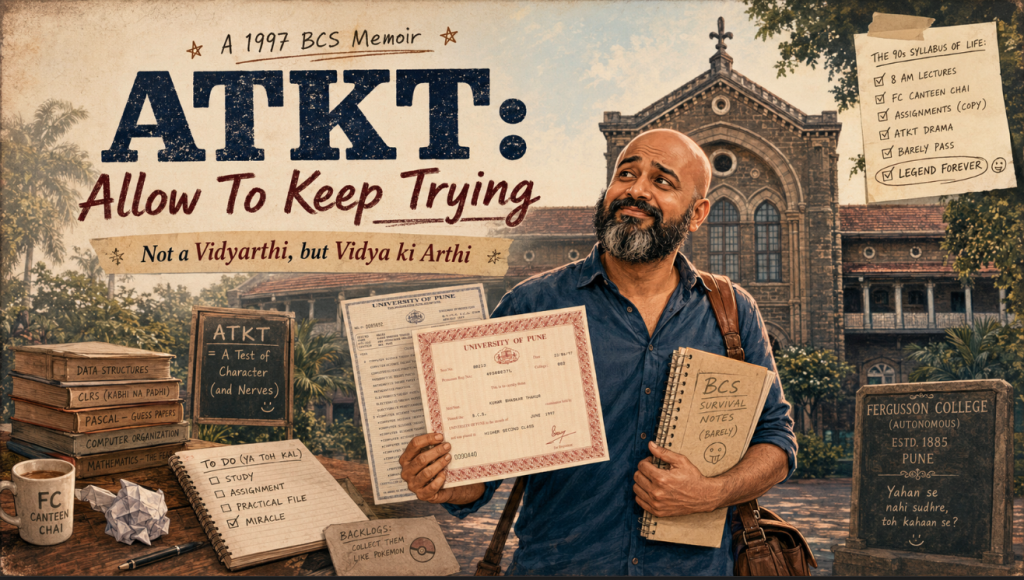
Chapter 1, Part 2: ATKT
When I finally reached Pune, I was not a student.
I was not even close to being a student, with just passing marks in all subjects.
I was a 19-year-old boy from Jamshedpur carrying a suitcase, a mark sheet, a ₹5,000 banker’s cheque, and the kind of confidence usually found only in Bollywood side characters who enter Mumbai and say, “Ek din main bada aadmi banunga.”
The problem was simple.
My 12th marks were so bad that no engineering college wanted to make me an engineer.
This was not rejection. This was quality control.
Engineering colleges looked at my marks and collectively said, “Beta, India has enough infrastructure problems. Please don’t add to them.”
In those days, engineering was the default dream. If you were from a middle-class family and had taken science, there were only three respectable endings to your story:
Doctor.
Engineer.
Failed doctor becoming engineer.
I had achieved the fourth category: neither.
I had not cleared any serious entrance exam. I had not secured admission anywhere. But I had one powerful Indian asset: someone knew someone who knew someone.
This someone told me there was a course in Pune called BCS.
Bachelor of Computer Science.
It sounded modern. It sounded respectable. Most importantly, it sounded close enough to engineering to confuse my relatives.
BCS was somewhere between B.Sc. and engineering. Not fully engineering, not ordinary B.Sc., but with enough computers, electronics, mathematics, and practicals to make parents feel that their son had not completely fallen off the academic map.
It was like standing between two platforms.
On one side: Engineering Express.
On the other side: Plain B.Sc. Passenger.
And in the middle: BCS Local, slightly late, slightly confusing, but moving.
Fergusson College had a Computer Science department that had already been around since the mid-80s, which meant BCS was not some fly-by-night course invented by a coaching class in a basement. It had Computer Science, Mathematics, Electronics, practicals, and enough serious-looking subjects to make the degree certificate look heavy.
So I did what any desperate, ambitious, underqualified boy would do.
I got in touch with a guy.
Every Indian admission story has this guy.
He is never clearly introduced. He is not family. He is not college staff. He is not exactly an agent. He just appears in the story like a character from a Ram Gopal Varma film.
“Ho jayega,” he said.
These three words have destroyed more Indian families than bad monsoons.
“Ho jayega” means nothing is confirmed, but everyone should start behaving as if it is.
The donation was ₹5,000.
Today ₹5,000 may sound like a decent dinner bill in a fancy restaurant where they serve dal in a ceramic bowl and call it “slow-cooked lentil experience.”
But in 1994, ₹5,000 was serious money. For my parents, it was trust converted into a banker’s cheque. For me, it was admission, survival, dignity, and future—all printed on one small piece of paper.
And just like that, I entered college.
Not through merit.
Not through destiny.
Through jugaad, mild panic, and a banker’s cheque.
I became a BCS student.
Or as I like to say now: not a vidyarthi, but Vidya ki arthi.
Because while other students came to college to pursue knowledge, I came with four people mentally carrying my academic body on their shoulders.
“Ram naam satya hai, marksheet satya hai.”
The first year arrived like a rude landlord.
Until then, I had assumed college would be like films. Friends under trees. Canteen conversations. Occasional romance. Some light studying before exams. Then success.
But BCS had other plans.
Computer Science Theory. Mathematics. Electronics. Practicals.
These were not subjects. These were revenge mechanisms.
In school, if you did not understand something, you could still write three pages and hope the examiner rewarded your handwriting. In Computer Science, the compiler had no feelings. In Mathematics, the answer was either right or a personal insult. In Electronics, even current refused to flow in my favour.
By the end of first year, I had achieved something special.
ATKT.
Allowed To Keep Terms.
The most beautiful academic phrase ever invented by Indian universities.
It basically means: “You have not passed properly, but we are also tired of you, so please move ahead and carry your shame forward.”
For parents, ATKT sounded terrifying.
For students, ATKT was a negotiation tool.
When I told my parents, there was silence on the other side. The kind of silence that happens when a doctor says, “We need to discuss the report.”
“What is ATKT?” they asked.
Now this was my moment.
A weaker man would have confessed failure.
I became a consultant.
I explained that ATKT was not failure. It was flexibility. It was the university’s way of recognizing potential. It allowed a student to continue while simultaneously developing character, resilience, and back-paper management skills.
I may have even said, “It is better than getting just 60%.”
This was, of course, complete nonsense.
But I said it with confidence.
“See, if someone gets 60%, they become overconfident. But with ATKT, I stay grounded. I remain connected to reality.”
My parents were not convinced, but they were too far away to physically verify the academic disaster. Distance is a great educational buffer.
So I continued.
The next two years were not college life. They were bottom-line management.
Some students topped.
Some students failed.
I specialized in survival.
I was not chasing excellence. I was chasing eligibility.
Every exam had only one strategy: cross the line.
Not dominate. Not impress. Just cross.
If the passing mark was 40, I aimed for 41 with the precision of a NASA mission.
A good student looked at the paper and thought, “How do I score 80?”
I looked at the paper and thought, “Which question can save my life?”
There were subjects where I did not study the full syllabus. I studied probability.
Not the subject of probability. The probability of which chapters might come.
This was pre-AI India. We had our own predictive models.
They were called seniors.
“Last year recursion came. This year pointer pakka.”
“Electronics practical mein waveform aayega.”
“Maths Paper II mein agar theorem aaya toh gaya kaam.”
The library had books. We had rumours.
The college campus was beautiful. Fergusson had trees, old buildings, history, and that classic Pune intellectual air where even the crows looked like they had read P. L. Deshpande.
But inside me there was only one emotion: deadline.
Every year, somehow, I moved ahead.
Sometimes by studying.
Sometimes by luck.
Sometimes because the examiner was merciful.
Sometimes because my handwriting looked like it had suffered enough.
And then came the final mark sheet.
University of Pune.
Statement of Marks.
S.Y./T.Y. B.C.S. Exam.
April/May 1997.
There it was in official blue ink.
Name: Kumar Bhaskar Thakur
College: Fergusson College, Pune
Result: Higher Second Class
Higher Second Class??
Not Distinction.
Not “University Rank Holder.”
Not “Gold Medalist.”
But higher than Second?? I thought, “Beta, higher than second hai tu, FIRST hi ho ga.” That confusion has guided the rest of my life.
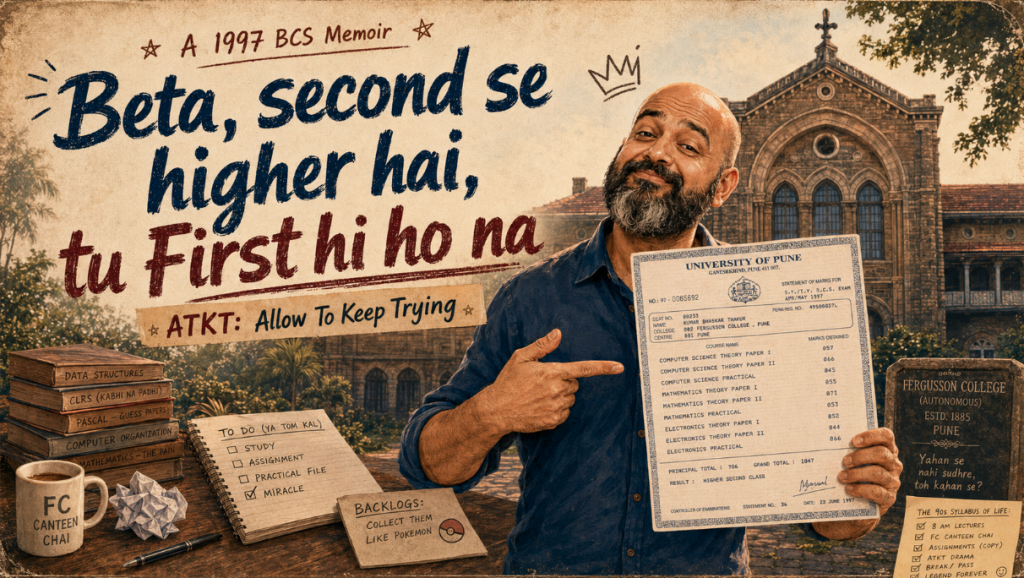
This was the academic equivalent of a train passenger travelling without reservation but somehow getting a side lower berth.
The grand total was 1047.
The principal total was 706.
These numbers may not impress anyone today. But to me, they looked like poetry.
Because behind every mark was a small escape.
Computer Science Theory Paper I: survived.
Computer Science Theory Paper II: survived.
Mathematics: survived.
Electronics: mostly survived.
Practicals: surprisingly alive.
The final certificate came dated 23/06/97.
It said that I had passed the B.C.S. examination held by University of Pune in June 1997 and was placed in Higher Second Class.
I stared at that certificate like it was a freedom document.
Not because I had conquered academics.
Because academics had failed to kill me.
For my mother, it was relief.
Their son had gone from Jamshedpur to Pune with no admission, lost his train once, got into a course through a mysterious guy, collected ATKT like loyalty points, and still came out with a degree.
For me, it was the first proof that life does not always reward toppers.
Sometimes it rewards people who refuse to leave the exam hall.
Looking back, BCS did something very important for me.
It did not make me a brilliant computer scientist.
Let us not insult computer science.
But it gave me proximity to the digital world just when India was beginning to change. Computers were not yet in every pocket. The internet was not yet a reflex. Software was not yet the default career ladder of the Indian middle class.
We were standing at the edge of something.
At that time, I did not know it.
I was too busy calculating how many marks were needed to pass.
But somewhere between Computer Science practicals, electronics labs, and those near-death mathematics papers, I had entered the world that would shape the next 25 years of my life.
The same boy who could not get into engineering would later build internet businesses.
The same boy who struggled through BCS would spend a career around digital evolution.
The same boy who explained ATKT as a positive development to his parents would later explain growth strategy to clients with a straight face.
So maybe ATKT was useful after all.
It trained me early in storytelling.
Because if you can convince your parents that ATKT is better than 60%, you can probably pitch anything in life.
My BCS degree was not glorious.
It was not inspirational in the standard LinkedIn way.
There was no “I topped despite all odds.”
There was no “From failure to gold medal.”
There was no dramatic professor saying, “This boy will change the world.”
There was just a slightly confused boy, a lot of back-door optimism, a few dangerous subjects, one ₹5,000 donation, and a final certificate that said:
Passed.
Higher Second Class.
Sometimes, that is enough.
Because life does not always begin with distinction.
For some, life is ATKT. Allow To Keep Trying
And if you keep terms long enough, one day life also allows you to keep moving.

What a story and what story telling !
You’re turning a new page Bhaskar, keep writing and sharing your life chapters, in your own unique way.
Amazing storytelling Bhaskar. You are going from strength to strength.
Dramatic, straight and factual .. and yet sounds like a screenplay suited to make a powerful 3 Idiots level success story.