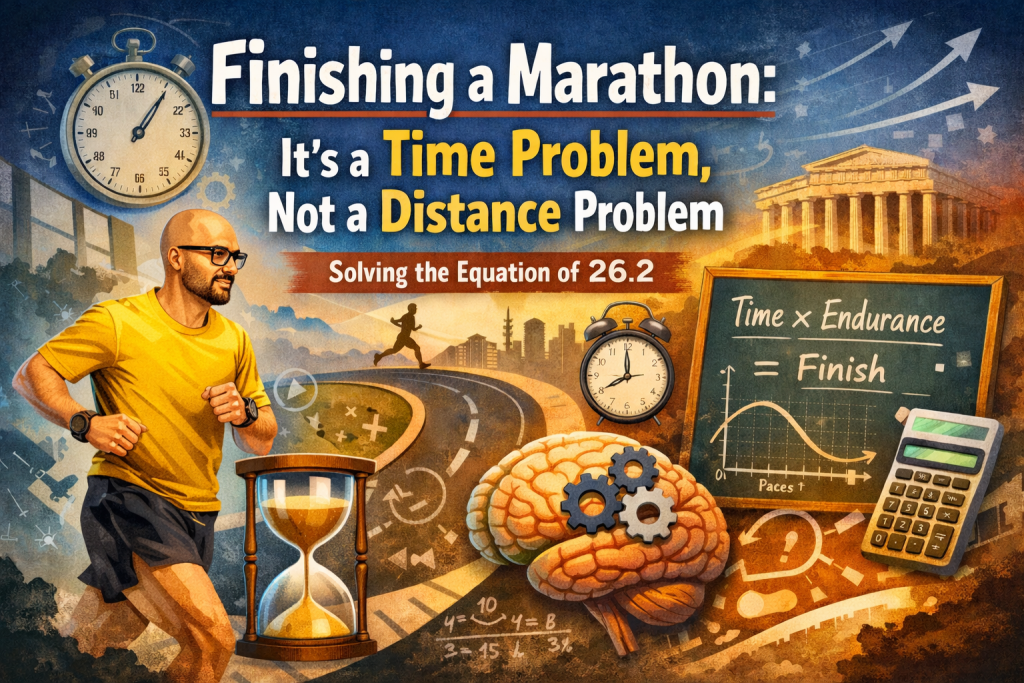
Every marathoner knows the number by heart: 42.195 km.
Some even romanticise it—26.2 miles of glory, grit, and questionable life choices.
But if runners were mathematicians, they would quietly push the distance aside, pick up a chalk, and write a different equation on the board:
Marathon = Managing Time in Space
Because on race day, your body doesn’t fail at kilometre 37.
It fails at minute 180… or 210… or 240.

Time & Space: The Forgotten Math of Running
In physics, space is where something happens.
Time is how long it happens.
Running a marathon is simply your body moving through space while surviving time.
A few classic “runner math” problems:
- Problem 1:
If you run at 5:00/km pace, when does fatigue arrive?
(Answer: not at 30 km, but around 2.5–3 hours for most humans.) - Problem 2:
Two runners finish 42.2 km.
One trains 3.5 hours long runs, the other tops out at 2 hours.
Who fades less after hour 3?
(Distance equal. Time adaptation unequal.) - Problem 3:
If glycogen depletion begins after ~120 minutes,
should your long run be designed around distance or time on feet?
Math whispers the answer. Ego argues back.
A Short Detour Into Marathon History (Because Every Equation Has a Backstory)
The marathon didn’t start as a GPS-certified loop with hydration stations every 2 km.
It comes from the legend of a messenger running from Marathon to Athens to deliver news of victory.
He didn’t know the distance.
He only knew one thing:
Run until the job is done… or until time runs out.
The modern marathon distance was standardised much later, but the human challenge remained unchanged:
Can your body survive sustained effort for a long period without breaking down?
History wasn’t asking how far.
It was asking how long.
Reframing the Marathon as a Solvable Problem
If the marathon is a time problem, then training must prepare you for time exposure, not just distance accumulation.
Strip away the noise, the fancy plans, and the Instagram workouts—and you’re left with four variables.
That’s it. No more.
The Only 4 Workouts Needed to Solve the Marathon Equation
1️⃣ Base (Zone 2): The Foundation of Time
- Purpose: Teach your body to exist comfortably for long durations
- Think: Mitochondria, fat metabolism, patience
- Prescription:
60–90 minutes, not “10–12 km”
Zone 2 is not slow.
It’s economical over time.
2️⃣ Intervals: Stretching the Speed Ceiling
- Purpose: Improve oxygen usage and efficiency
- Think: Short bursts, controlled suffering
- Prescription:
Total hard time = 15–30 minutes
(Not “8 × 800 m” because terrain, fatigue, and pace vary.)
3️⃣ Threshold Runs: Teaching the Clock Who’s Boss
- Purpose: Raise the pace you can hold for a long time
- Think: “Comfortably uncomfortable”
- Prescription:
20–40 minutes at threshold, continuous or broken
Threshold is not about speed.
It’s about how long you can delay the inevitable.
4️⃣ Long Runs with Marathon Pace Segments: Reality Check
- Purpose: Simulate race stress without racing
- Think: Fuel, fatigue, form under time pressure
- Prescription:
2.5–3.5 hours total, with
30–60 minutes at marathon pace, placed late
The body doesn’t care if this is 28 km or 34 km.
It only knows: I’ve been working for a long time… and now you want me to go faster.
Welcome to the exam.
Why Time-Based Training Works Better (Especially for Real Life Runners)
- Terrain changes → time stays honest
- Weather changes → time stays fair
- Fatigue changes → time stays relevant
Distance is fixed.
Effort over time is not.
That’s why two runners can run the same 32 km long run—and one recovers smiling while the other questions life choices.
Same space.
Different time cost.
Over to You (Yes, You With the Training Plan)
Now I’m curious:
- Do you train by distance or time?
- What’s your longest time-on-feet, not longest run?
- How do you structure your long runs—pure easy or pace-aware?
- Have you noticed fatigue arriving by the clock rather than the kilometre marker?
Drop your thoughts, plans, and counter-arguments.
Math welcomes debate.
And Finally…
Wish you all a very happy 26.20.
Oops sorry… very happy 2026.
Oops sorry…
Wish you a happy 26.20 in 2026. 🏃♂️➗⏱️

Thank you for the in-depth analysis and for clearly highlighting the differences between time-based and distance-based training for a full marathon. I find this article extremely useful for runners.
A different take which most know but often forgotten. Time based training plan is for all levels of runners, in fact it doesn’t add more fatigue to your body, than it can take, if done with a coach.
A good perspective for serious runners who are focussed on getting better.