When I started running in 2014, I thought running was a low-cost sport.
Shoes, shorts, T-shirt, road.
Simple.
Then I discovered gels.
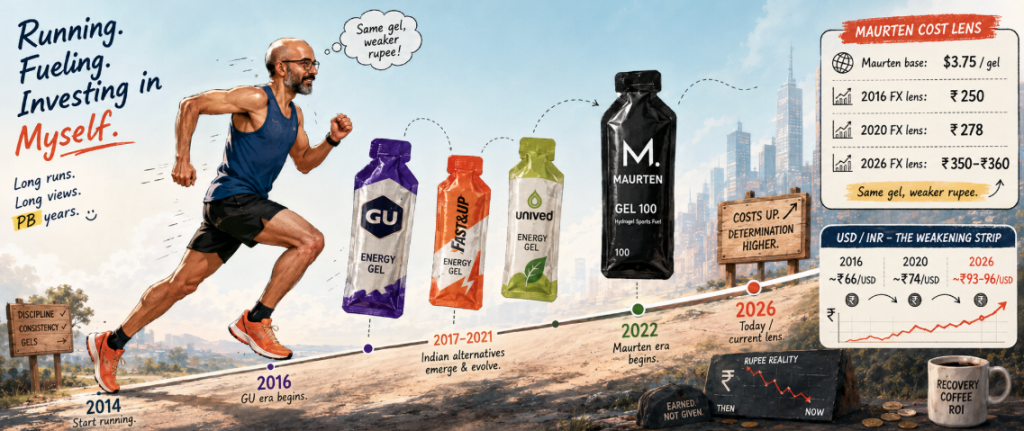
In 2016, I started using GU. Later came Fast&Up and Unived, which gave Indian runners some local relief. Then around 2022, I discovered Maurten, and suddenly my marathon nutrition plan started looking like an imported luxury item.
The problem was not just that gels became premium.
The problem was that the rupee also started running its own marathon — mostly downhill.
USD-INR and My Running Years
| Year / FY | Approx. USD-INR | Running Interpretation |
|---|---|---|
| 2014–15 | ₹61.14 | I was new. The rupee still had dignity. |
| 2015–16 | ₹65.47 | I began racing more. Imported gels started whispering. |
| 2016–17 | ₹67.07 | GU entered my life. So did forex exposure. |
| 2017–18 | ₹64.45 | Brief rupee relief. Runner still optimistic. |
| 2018–19 | ₹69.92 | Cost per gel quietly rising. |
| 2019–20 | ₹70.90 | Running was no longer a hobby; it was a category. |
| 2020–21 | ₹74.23 | Pandemic year. Rupee weaker, motivation variable. |
| 2021–22 | ₹74.50 | Return to races. Return to expenses. |
| 2022–23 | ₹80.36 | Maurten era begins. Wallet starts tempo run. |
| 2023–24 | ₹82.79 | Imported nutrition fully premiumized. |
| 2024–25 | ₹84.58 | Age up, pace down, gel cost up. |
| 2026 current | ~₹93–96 | Rupee hits super-shoe pace, but in the wrong direction. |
My PB Runs Through the Maurten Lens
Now comes the painful part.
What would one Maurten GEL 100 have cost in rupees in that month?
For this table, I am using Maurten GEL 100’s current US pricing as the base: a box of 12 servings is listed by Maurten, and the page shows $9.38 per 100g; since one gel is 40g, that works out to roughly $3.75 per gel. Maurten also says GEL 100 gives 25g carbohydrates per serving. The rupee cost below is simply that $3.75 converted using the approximate USD-INR exchange rate for that race month. This is an index, not my actual historical purchase bill.
One run per year, one gel, one exchange-rate reality check.
| Year | Run | Approx. USD-INR | Maurten Cost / Gel in USD | Maurten Cost / Gel in INR |
|---|---|---|---|---|
| 2016 | Pune Marathon | ₹67 | $3.75 | ₹251 |
| 2017 | SCMM / Mumbai Marathon | ₹64 | $3.75 | ₹240 |
| 2018 | Ladakh / Goa running phase | ₹70 | $3.75 | ₹263 |
| 2019 | New Delhi Marathon | ₹71 | $3.75 | ₹266 |
| 2020 | Pune Ultra 100K | ₹74 | $3.75 | ₹278 |
| 2021 | Hell 480 Virtual | ₹75 | $3.75 | ₹281 |
| 2022 | Adani Ahmedabad Marathon | ₹80 | $3.75 | ₹300 |
| 2023 | Valencia Marathon | ₹83 | $3.75 | ₹311 |
| 2024 | London Marathon | ₹84 | $3.75 | ₹315 |
| 2025 | New Delhi Marathon | ₹85 | $3.75 | ₹319 |
| 2026 | Same gel today | ₹93–96 | $3.75 | ₹349–₹360 |
The gel did not become bigger.
The carbohydrates did not become more emotional.
The packet did not start playing motivational music at 32K.
But the rupee quietly moved from the mid-60s to the mid-90s.
So the same imported gel that would have been around ₹250 during my 2016 PB phase becomes roughly ₹350–₹360 in today’s exchange-rate environment, even before Indian retail margins, shipping, duties, and the runner’s insecurity premium.
The Imported Gel Formula
A foreign gel does not cost only what the packet says.
It costs:
Global price × USD-INR + import duty + distributor margin + runner anxiety premium
That last part is important.
Because no recreational runner buys a premium gel only for carbohydrates. We buy it because at 32K, we want to believe that one sachet can fix training gaps, bad sleep, poor pacing, and the paratha eaten the previous night.
The Real Damage
This is where the financial analyst in me starts sweating more than the runner.
In 2016, a Maurten-equivalent imported gel at $3.75 would have translated to roughly ₹250.
In 2026, the same $3.75 gel translates to around ₹350–₹360.
Same gel.
Same calories.
Same questionable texture.
Higher rupee damage.
Analyst View
Runner age: depreciating asset.
Rupee: depreciating currency.
Imported gels: appreciating cost centre.
PB probability: volatile.
Race stories: long-term compounder.
My conclusion is clear.
Between 2014 and now, I have not just run races.
I have participated in a long-term case study of currency depreciation, product premiumization, and biological slowdown.
The rupee got weaker.
The gels got costlier.
I got older.
And somehow, my race kit still has space for one more overpriced sachet of hope.
As a financial analyst, my recommendation is clear:
Running remains a strong buy. Imported gels are a hold. The rupee is under review.

Love this – Because no recreational runner buys a premium gel only for carbohydrates. We buy it because at 32K, we want to believe that one sachet can fix training gaps, bad sleep, poor pacing, and the paratha eaten the previous night.