In 1993, I was in Class XI.
That wonderfully pointless year between two Indian national events called Class X Boards and Class XII Boards.
Nobody really remembers Class XI.
I was 18.
Not a particularly good student. Not particularly sure what I wanted to become. Life had also decided to throw in a few challenges that weren’t part of the CBSE syllabus.
And somewhere in all this, I got access to a cassette.
Not an original cassette, obviously.
A duplicate cassette.
Although in 1993, we didn’t call it piracy.
Piracy involved ships, eye patches and Amitabh Bachchan occasionally smuggling something near a dockyard.
We simply called it:
“Cassette copy kar dena.”
Someone had Bat Out of Hell II: Back into Hell. Someone had a double-deck cassette player. Someone bought a blank TDK or Sony cassette.
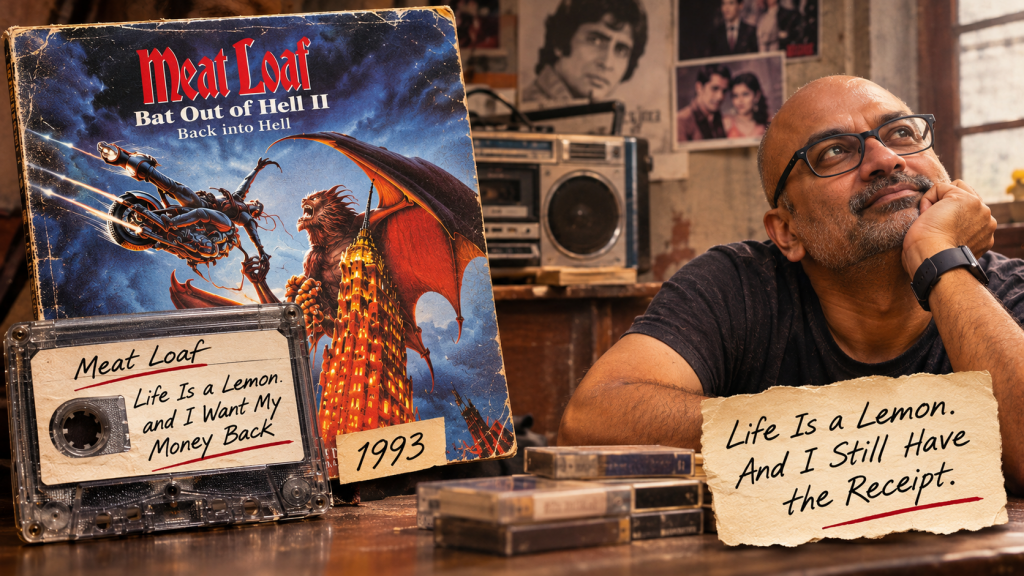
Technology did the rest.
Spotify hadn’t been born.
Neither had Napster.
Neither had the Indian teenager’s guilt about intellectual property.
And that’s how Meat Loaf entered my life.
Life Is a Lemon
There was one song on that cassette that sounded different.
Angry.
Almost unreasonable.
Life Is a Lemon and I Want My Money Back.
At 18, I loved the line.
I don’t think I understood it.
I probably interpreted it literally in the way teenagers interpret most philosophy:
Life sucks. Refund please.
It sounded rebellious.
And rebellion in 1993 was attractive.
Because most of the Indian entertainment around us was teaching us something completely different.
Bollywood had already explained the operating manual of life.
Be good.
Work hard.
Love sincerely.
Respect your parents.
Fight the villain.
And eventually everything will work out.
If things became particularly difficult, wait for the second half.
Bollywood Had a Very Generous Refund Policy
We grew up on movies where life eventually balanced its books.
In Deewaar, two brothers could take completely different roads, but morality would eventually audit both accounts.
In Muqaddar Ka Sikandar, suffering could at least be converted into magnificent dialogue and background music.
In Karz, if one lifetime wasn’t sufficient to settle the account, Bollywood gave you another one.
Imagine that customer service.
“Sir, we apologise for the inconvenience in your previous birth. Your complaint has been escalated to Reincarnation.”
In Amar Akbar Anthony, three children could get separated, grow up under three different religions, accidentally meet again and eventually discover the same mother.
Try losing three children today and asking Google Maps to reproduce that plot.
And then there was the ultimate Bollywood promise:
If you were the hero, the universe owed you an ending.
Maybe not immediately.
Maybe after 14 songs, three misunderstandings, one hospital scene and Amrish Puri.
But eventually.
Justice.
Love.
Success.
Closure.
Money back.
Except Meat Loaf Wasn’t Offering a Happy Ending
That song kept coming back to the same complaint.
Something was defective.
Something had been promised.
Something hadn’t been delivered.
Therefore:
I want my money back.
For more than three decades, that remained a great song from a great album from a very particular time in my life.
Until recently, when I realised something.
The money isn’t money.
At least not for me anymore.
The refund being demanded isn’t ₹500.
Or ₹5 lakh.
Or ₹5 crore.
The currency is life.
Time.
Expectations.
Relationships.
Dreams.
Effort.
The person you thought you would become.
The people you assumed would always remain around you.
The things you postponed because there would always be next year.
That is the money.
And suddenly a song I heard on a duplicated cassette in 1993 sounds very different in 2026.
The Problem With Being 18
At 18, you think life is something that is about to happen.
At 51, you realise:
This is it. It has been happening all along.
There was no opening ceremony.
No Amitabh voice-over.
No title card saying:
BHASKAR THAKUR — THE STORY BEGINS
You were busy attending college, getting jobs, losing jobs, starting things, abandoning things, loving people, fighting with people, making money, losing money, running somewhere, returning somewhere.
And while you were preparing for life…
life quietly deducted the instalments.
No OTP.
No notification.
No refund policy.
I Was Also Sold a Few Things
Like most people of my generation, I was sold some fairly standard products.
Study well.
Get a degree.
Get a job.
Build a career.
Earn money.
Buy things.
Become respectable.
Somewhere between Hum Aapke Hain Koun..! and LinkedIn, respectability became Personal Branding.
Somewhere between a Maruti 800 and Scorpio , transportation became Lifestyle.
Somewhere between neighbourhood cricket and Garmin, exercise became VO2 Max.
And somewhere between “What do you want to become when you grow up?” and turning 50, you realise nobody ever tells you:
When exactly have you grown up?
Because I am still waiting.
Then You Start Asking for the Refund
Not because life was bad.
Quite the opposite.
Because eventually you understand what you actually paid.
Every choice had a price.
Every yes killed a possible no.
Every road taken quietly erased another road.
Every year spent becoming something was also a year spent not becoming something else.
That’s the invoice nobody gives you.
And perhaps that is why the song feels more intelligent today than it did in 1993.
At 18, I heard anger.
At 51, I hear accounting.
But There Is One Small Problem
Who exactly do you ask for the refund?
God?
Parents?
Society?
Your boss?
Your spouse?
Your school?
CBSE?
LinkedIn?
Garmin?
The government?
Your younger self?
There is no customer-care number printed on the back of life.
And even if there were, I suspect the automated response would say:
“Your call is important to us. You are currently caller number 8,231,456,719.”
Please continue holding.
For approximately one lifetime.
Maybe That Was the Point
Perhaps the song was never really about getting anything back.
Perhaps the power is in recognising that you can’t.
You cannot return 1993.
I cannot walk back into Class XI.
I cannot put that duplicated cassette into the player again for the first time.
I cannot become the person I might have become had I taken another road.
And frankly, I am no longer sure I want to.
Because the strange thing about life is that the defective product creates the customer.
The wrong turns become stories.
The bad decisions become judgement.
The failures become humour.
The losses create perspective.
The boring years acquire meaning decades later.
And a song recorded by Meat Loaf in 1993 waits patiently on a cassette somewhere in your memory until you are old enough to understand it.
No Refund. Store Credit Maybe.

Bollywood taught us that eventually the hero gets an answer.
Meat Loaf demanded his money back.
Life offers neither.
It simply gives you another morning.
Another kilometre.
Another argument.
Another idea.
Another person to love.
Another opportunity to screw something up.
And occasionally, another chance to fix it.
Maybe that’s the store credit.
You don’t get your money back.
You get today.
Spend it.
Because somewhere, an 18-year-old version of you is still sitting beside a cassette player, convinced that life hasn’t started yet.
He doesn’t know the cassette is already running.
He doesn’t know Side A will end.
He doesn’t know there is no rewind.
And he definitely doesn’t know that more than three decades later, he will finally understand the title of the song.
Life is a lemon.
Do I want my money back?
Nah.
I’ve already consumed the product.
And despite everything—
I think I got my money’s worth.
