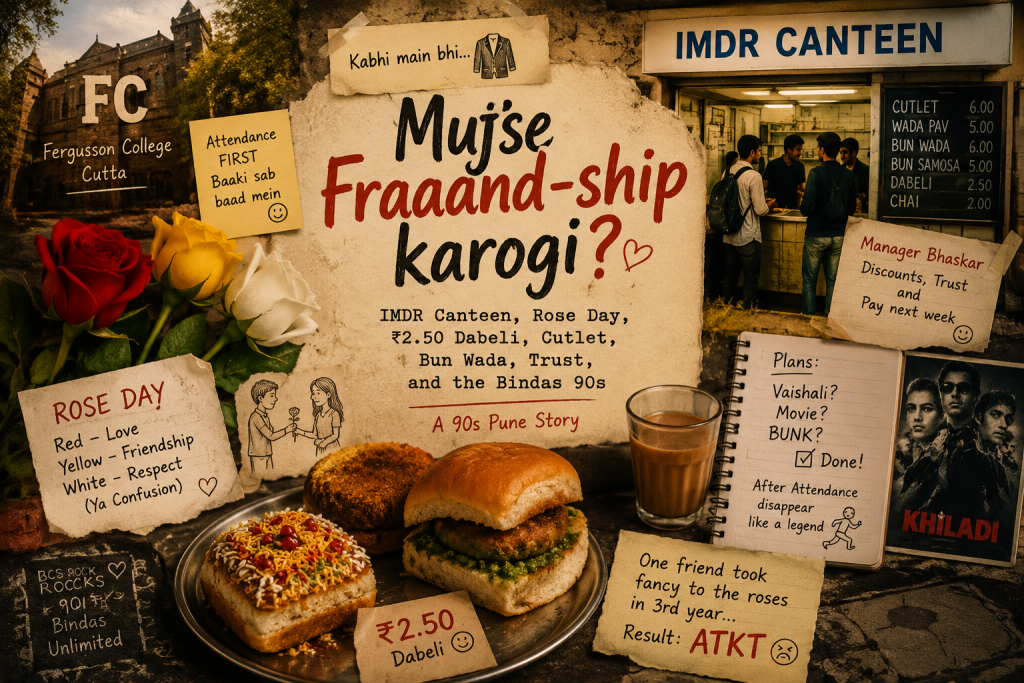
IMDR Canteen, Rose Day, ₹2.50 Dabeli, and the Last Days of Trust
Some memories don’t come back as full stories. They come back as smells, prices, snacks, and half-forgotten phrases, that friends share on WhatsApp chat. This blog is inspired with onne such weekend WhatsApp chat after the ATKT blog.
I credit Ashish, Rama, Prity, Umesh and others for the content of this blog. I have used expressions they used in the blog.
For me, IMDR canteen is one of those memories.
It comes back with the smell of cutlet, bun wada, bun samosa, wada pav, ₹2.50 dabeli, and those glorious telkatgoodies that we were shamelessly hooked on. It comes back with FC, BCS, Vaishali, JM Road, Shiv Sagar, Thums Up bottles, cash payments, money orders, bunking plans, fake fainting episodes, and the general overconfidence of being young in 90s Pune.
IMDR canteen was not just a canteen. It was an adda. It was an economy. It was a counselling centre. It was a romance decoding station. It was a place where hunger, friendship, credit, aspiration, and confusion were all served hot.
And sometimes with sambhar.
IMDR was part of DES — Deccan Education Society — so for us Fergusson College types, it never felt like some faraway management institute. We could easily jump from FC to IMDR. It felt like crossing from one pocket of student life to another.
The main attraction, of course, was food. Cheap, filling, oily, happy food. A cutlet could fix your mood. A bun wada could extend your day. A bun samosa could create hope where attendance had destroyed it. And ₹2.50 dabeli was not just a snack. It was a financial instrument.
But IMDR also had a slightly different air. It was a management institute. There were students just a few years older than us, walking around in blazers, looking like they had already received appointment letters from adulthood.
At that age, a blazer was not a garment. It was a vision statement.
We were still trying to figure out whether we had enough money for one more snack. They looked like they were figuring out markets, brands, careers, and corporate life. Somewhere between one cutlet and another, I would look at them and think:
Kabhi main bhi…
Not as the main emotion. The main emotion was still hunger. But yes, there was a small side serving of aspiration.
And then there was Rose Day.
Back in those days, there was something called Rose Day. It was our generation’s low-budget, high-risk relationship management system. Guys gave roses to girls based on what they wanted to say but did not have the courage to say directly.
A white rose meant something.
A yellow rose meant something else.
A red rose meant either bravery, foolishness, or both.
There were no WhatsApp blue ticks, no Instagram stories, no “seen at 9:42 PM”, no relationship status, no soft launch, no hard launch. Just one rose and enough emotional pressure to derail an academic year.
And of course, there was the Khiladi hangover.
After Khiladi, college romance had acquired suspense, background music, and unnecessary seriousness. A simple rose could feel like a plot twist. A yellow rose could be friendship, possibility, rejection, or “beta, better luck next year.” A red rose could create hope. A white rose could be declared “just friendship” while the poor fellow’s internal background score was already playing.
One of my friends took such a fancy to the roses in third year that academics quietly moved to the back bench.
Result?
ATKT.
That was the beauty of our times. Some people got ATKT because of mathematics, some because of programming, and some because of fraaand-ship. This is why I have always believed ATKT was not just “Allowed To Keep Terms.” It was actually Allowed To Keep Trying.
Trying in studies.
Trying in life.
Trying in love.
Trying to understand what yellow rose really meant.
In that world, IMDR canteen became the perfect background location. You could eat a cutlet, discuss who gave whom which rose, pretend to be casual, and spend the whole day decoding one flower like it was a government tender document.
But the real magic of IMDR canteen was not just food, aspiration, or Rose Day drama.
For me, the best thing about IMDR canteen was the manager — Bhaskar.
He used to give me discounts because we were both “Bloody Bhaskar.” That was enough qualification. No loyalty card, no app, no coupon code, no cashback. Just shared name-based customer relationship management.
And at the end of the month, when my money order had not reached, he would allow me to pay a week later.
Think about that now.
Today, we have fintech, credit scores, BNPL, wallets, UPI, food delivery apps, payment reminders, OTPs, KYC, and ten different ways to prove we are trustworthy. Back then, a canteen manager looked at a broke student and said, “Pay later.”
That was it.
No form.
No interest.
No penalty.
No collection call.
No push notification saying, “Your bun wada payment is overdue.”
Life was so simple. We had cash and we paid in cash. And when we did not have cash, someone trusted that we would come back.
That trust was not limited to the canteen. It was everywhere in small ways. Thums Up bottles on JM Road were not locked up like high-security assets. Friends from other states found families who accepted them. Plans were made casually. Help was given without making a LinkedIn post about empathy.
We had complicated lives in many ways, but the system was simpler. Or maybe the system was weak, but people were stronger.
Looking back, IMDR canteen feels like a symbol of that time.
It was where ₹2.50 mattered.
Where cutlet had international recall value.
Where bun wada with sambhar was a legitimate meal plan.
Where blazers made us think “Kabhi main bhi.”
Where Rose Day made us think “Mujse fraaand-ship karogi?”
Where one friend’s romantic enthusiasm could become another ATKT case study.
Where Manager Bhaskar gave discounts to another Bhaskar.
Where credit did not need an app because trust had not yet been outsourced to software.
IMDR canteen was not a five-star memory. It was not polished. It was not gourmet. It was not Instagrammable.
Thank God for that.
It was oily, crowded, affordable, noisy, emotional, and human.
And maybe that is why it has stayed.
Because we thought we were going there for cutlet, dabeli, bun wada, and timepass.
But looking back, IMDR canteen was serving something much bigger.
It was serving friendship.
It was serving trust.
It was serving small-town boys and girls trying to become city adults.
It was serving heartbreak wrapped in Rose Day colour coding.
It was serving ambition in the background, wearing a blazer.
It was serving credit before credit scores.
It was serving a version of life where a rose could ruin your week, a cutlet could fix your mood, and a canteen manager could restore your faith in humanity.
Before UPI, wallets, DMs, dating apps, food apps, and relationship statuses, there was IMDR canteen.
And somewhere near it, a confused young man was still trying to understand whether yellow rose meant friendship, future, or full stop.
