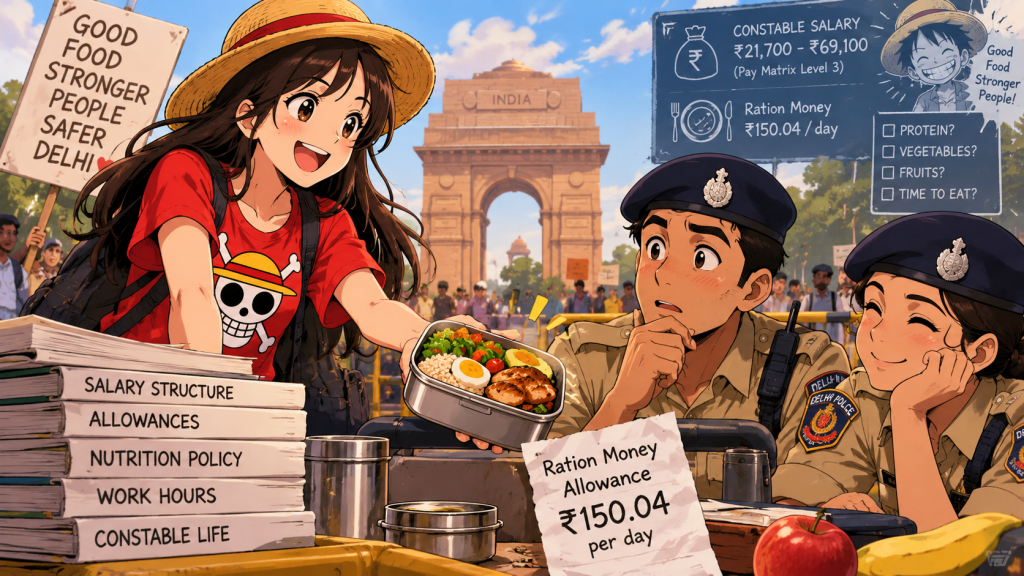
How an anime girl accidentally made me investigate what Delhi’s constables eat
I had a question this week that I never expected to ask.
How much does it cost to feed a Delhi Police constable?
Not train one.
Not recruit one.
Not give him or her a uniform, lathi, barricade, wireless set or instructions to prevent citizens from reaching Jantar Mantar.
Just:
Khana kitne ka milta hai?
The question came to me because somewhere in Delhi, amidst barricades, slogans, police vans and the usual Indian democratic choreography, a young woman appeared wearing a red T-shirt carrying the skull-and-straw-hat symbol from the Japanese manga and anime One Piece.
That woman was student activist Neha Bora.
The One Piece Jolly Roger has apparently travelled from manga pages to Gen-Z protests in Indonesia, Nepal and elsewhere, and in October 2026 it reached Delhi too. (The Indian Express)
Naturally, India responded in the most Indian way possible.
We discussed the T-shirt.
I became interested in something else.
Had Monkey D. Luffy finally discovered the nutritional vulnerability of the Delhi Police?
Because if there is one thing One Piece teaches you, it is that revolutions are complicated.
But hunger is very simple.
First, meet the Delhi Police constable
This isn’t an underpaid ₹12,000-a-month private security guard.
A Delhi Police Constable (Executive) is a Central Government Group C employee.
The 2026 recruitment rules place the post at Pay Matrix Level 3: ₹21,700–₹69,100. (Gazette Tracker)
So let us take a newly recruited constable at the bottom of the scale.
Basic Pay: ₹21,700 per month.
From January 2026, Central Government DA is 60% of basic pay. (Press Information Bureau)
That gives our hypothetical new constable approximately:
Basic: ₹21,700
DA @ 60%: ₹13,020
HRA @ 30%, if eligible: ₹6,510
Transport allowance: ₹3,600 + DA on the allowance, approximately ₹5,760
And then comes my favourite line in the entire government compensation architecture:
Ration Money Allowance.
Delhi Police’s published allowance schedule lists ration money for personnel from Constable to Inspector at ₹150.04 per day. (Delhi Police)
Read that again.
₹150.04.
Not ₹150.
The four paise matter.
This is government nutrition.
Calories may fluctuate.
Precision cannot.
₹150.04: The Great Delhi Police Diet
At ₹150.04 per day, thirty days of ration money works out to roughly:
₹4,501 per month.
So a rough monthly compensation calculation for our starting constable, before deductions and depending upon eligibility for allowances, looks like this:
| Component | Approx. amount |
|---|---|
| Basic pay | ₹21,700 |
| DA | ₹13,020 |
| HRA, if eligible | ₹6,510 |
| Transport + DA | ₹5,760 |
| Ration money | ₹4,501 |
| Cycle allowance, where applicable | ₹180 |
| Approx. gross | ₹51,671 |
This is illustrative rather than a payslip because actual salary depends on accommodation, deductions, posting, increments and eligibility.
But the important number for this story isn’t ₹51,671.
It is:
₹150.04.
Because ₹150.04 is apparently the financial bridge between a constable and adequate daily nutrition.
So what can ₹150 buy in Delhi?
This is where economics meets protein.
Imagine someone doing a physically demanding job involving long hours standing outside, Delhi summers, Delhi winters, crowd control, walking, running, irregular shifts and occasionally discovering that 300 people have decided to go somewhere their superiors have decided they should not go.
Ideally, this human being needs regular meals containing carbohydrates, protein, vegetables, fruit and adequate hydration.
₹150 is not starvation money.
You can absolutely eat for ₹150.
Millions of Indians do.
The more interesting question is:
Can you consistently eat well for ₹150 while working unpredictable police shifts in Delhi?
That distinction matters.
Dal-chawal is food.
Chole-bhature is food.
Two samosas and chai are also technically food.
But none of them automatically constitutes an occupational nutrition programme.
Delhi Police does have an extensive welfare apparatus—wellness centres, welfare centres, police canteens, fitness facilities and health programmes. Its welfare material even includes a circulated item titled “Nutrition-Lecture note.”(Delhi Police)
Which is wonderful.
Because nothing restores glycogen after twelve hours of crowd-control duty quite like…
a lecture note.
The problem isn’t theoretical
This is where the joke stops being entirely a joke.
A recent study involving 374 police personnel in Delhi found that 68.5% worked more than 48 hours per week.
Nearly one in five worked more than 72 hours per week.
And 79.9% reported fewer than four holidays a month. (PubMed Central (PMC))
Now look at what police personnel themselves identified among their occupational stressors:
Eating healthy at work.
Finding time to stay in good physical condition.
Fatigue.
These weren’t observations made by Twitter nutritionists.
They came from police personnel participating in the study. (PubMed Central (PMC))
Another NCR study of police personnel found substantial lifestyle-health problems, including inadequate fruit and vegetable intake and physical inactivity among those reporting health complaints. (PubMed Central (PMC))
So perhaps the ₹150 question deserves more attention than the T-shirt.
Enter: Anime Girl
Now return to our protagonist.
A young woman arrives wearing a One Piece T-shirt.
One Piece, for people of my generation who still instinctively believe cartoons should involve Tom chasing Jerry, is a Japanese manga/anime about pirates, freedom, power and a young man called Monkey D. Luffy.
Luffy also eats like someone whose Ration Money Allowance has finally been sanctioned retrospectively.
His relationship with food is legendary.
Which makes the symbolism almost too perfect.
On one side:
Gen Z + Anime + One Piece.
On the other:
Government of India + 7th Pay Commission + ₹150.04 Ration Money Allowance.
Forget ideology.
This is a clash of nutritional philosophies.
And then Delhi produced the perfect subplot
A few days later, another video from the protest went viral.
A protester approached two women police officers.
One officer asked whether she had eaten.
Another reportedly offered:
Give her my share. I don’t feel like eating today.
The policewoman was offering her own lunch to the protester. (ABP News)
And suddenly the entire story became much more interesting.
Because beneath all the shouting, detention, barricades, political arguments and social-media outrage were two ordinary human beings discussing the most Indian question ever asked during a crisis:
“Khana khaya?”
This may be our true constitutional value.
Article 21 gives you the Right to Life.
Indian aunties upgraded it to:
Right to Life With Lunch.
Perhaps we are auditing the wrong thing
Every time there is a protest, television debates ask:
Who organised it?
Who funded it?
Who gave permission?
Who blocked whom?
Who provoked whom?
Who was detained?
Who was released?
Fair questions.
But perhaps we should add another.
Who fed the constable?
Because we expect extraordinary things from police personnel.
Stand for hours.
Stay alert.
Remain calm.
Control crowds.
Don’t lose your temper.
Don’t use excessive force.
Don’t abandon your post.
Don’t complain about the weather.
Don’t complain about the hours.
And please maintain the physical conditioning necessary to chase a 22-year-old who has been surviving on Maggi, Red Bull and revolutionary optimism.
For this, somewhere inside the administrative machinery sits the magnificently precise figure:
₹150.04 per day.
Salary is not the same as working conditions
This distinction is important.
Delhi Police constables aren’t unpaid.
They receive a proper government salary, DA, HRA where eligible, transport allowance, ration money, dress allowance and other welfare benefits. The published Delhi Police schedule lists an annual dress allowance of ₹12,500 for Constable-to-Inspector ranks, alongside the other allowances. (Delhi Police)
There are welfare centres.
Wellness centres.
Police canteens.
Fitness infrastructure.
Medical support.
The institution clearly spends money on personnel welfare. (Delhi Police)
The deeper problem is different.
You can give somebody a nutrition allowance.
You cannot give them time to eat the nutrition allowance.
You can build a gym.
You cannot exercise while standing behind a barricade for ten hours.
You can circulate a nutrition lecture.
But PDF mein protein nahi hota.
That may explain why the Delhi study found that police personnel themselves regarded eating healthily, maintaining fitness and fatigue as meaningful occupational problems. (PubMed Central (PMC))
The ₹150 Test
So I propose a new public-policy benchmark.
Forget Ease of Doing Business.
Forget Happiness Index.
Introducing:
The ₹150 Police Nutrition Test™
Take ₹150.
Go to Delhi.
Spend an entire day outdoors.
Stand for twelve hours.
Get breakfast.
Get lunch.
Get dinner.
Include adequate protein.
Include vegetables.
Include fruit.
Stay hydrated.
No Swiggy coupon.
No office pantry.
No mummy ka dabba.
And since this is Delhi Police:
Someone will randomly move your lunch break by three hours.
If you can successfully complete this experiment for thirty consecutive days, congratulations.
You are eligible to write India’s next Nutrition-Lecture Note.
The great irony
Perhaps the funniest part of the whole episode is that the apparent adversaries probably have more in common than social media would like us to believe.
The young protester is probably worried about her future.
The young constable is probably worried about his or hers.
One carries a placard.
One carries a lathi.
One receives instructions from WhatsApp groups.
The other receives instructions from senior officers.
Both probably have parents calling them at 9 PM asking:
“Beta, ghar kab aaoge?”
And both eventually need dinner.
The machinery surrounding them converts them into categories:
PROTESTER.
POLICE.
LEFT.
RIGHT.
ACTIVIST.
STATE.
But hunger has stubbornly refused to become ideological.
Which brings us back to One Piece
Maybe the anime T-shirt isn’t the most interesting symbol after all.
Maybe the important image is the policewoman offering her lunch.
Because despite all our sophisticated political theories, the Republic occasionally reveals itself through something ridiculously simple.
A constable reportedly gets roughly ₹150 a day as ration money.
A protester turns up.
The policewoman has food.
The protester may need food.
And somebody says:
“Mera wala de do.”
For a few seconds, nobody is Left.
Nobody is Right.
Nobody is Establishment.
Nobody is Resistance.
There are just two Indians and one lunchbox.
Perhaps Monkey D. Luffy understood India better than we thought.
Governments can control barricades.
Protesters can control hashtags.
Anime can control Gen Z.
But eventually—
sabko khana khana hai.
And if ₹150.04 is supposed to keep the people protecting India’s capital properly nourished through heat, cold, pollution, night duty and the occasional invasion by anime characters…
perhaps the biggest threat to law and order isn’t One Piece.
It is one piece of fruit, one decent serving of protein, and whether ₹150.04 can still buy both after lunch.
