There are three things that can probably explain India better than the Constitution.
Turmeric. RAM. And deep fry.
Let me explain.
Turmeric — haldi — is secular.
You cut your finger, haldi.
You have a cold, haldi doodh.
You are getting married, haldi.
You are not getting married because nobody likes your face, haldi on face.
You have a stomach problem, haldi.
Your mother doesn’t know what your problem is, still haldi.
For centuries, Indian mothers have operated on one medical principle:
Pehle haldi lagao. Problem baad mein identify karenge.
Then there is Ram.
For us Hindus, Bhagwan.
But Ram goes much beyond religion in India.
Ram Ram.
Hey Ram.
Ram bharose.
Ram jaane.
And my personal favourite when nobody has any clue what is happening:
Jo hoga Ram dekhega.
Then there is deep fry.
Probably India’s most successful national integration programme.
Rajasthan has bhujia and sev.
Tamil Nadu has murukku and mixture.
Bihar has bhujiya in forms that can turn a perfectly respectable plate of dal-chawal into something worth overeating.
Bengal deep-fries things that were already perfectly edible before being deep-fried.
Punjab can probably deep-fry the plate also.
Different languages.
Different religions.
Different cuisines.
One nation.
One oil temperature.
So somewhere between turmeric, Ram and deep fry, India has survived for thousands of years.
But I learnt this philosophy much later.
First, I had to survive Pune.
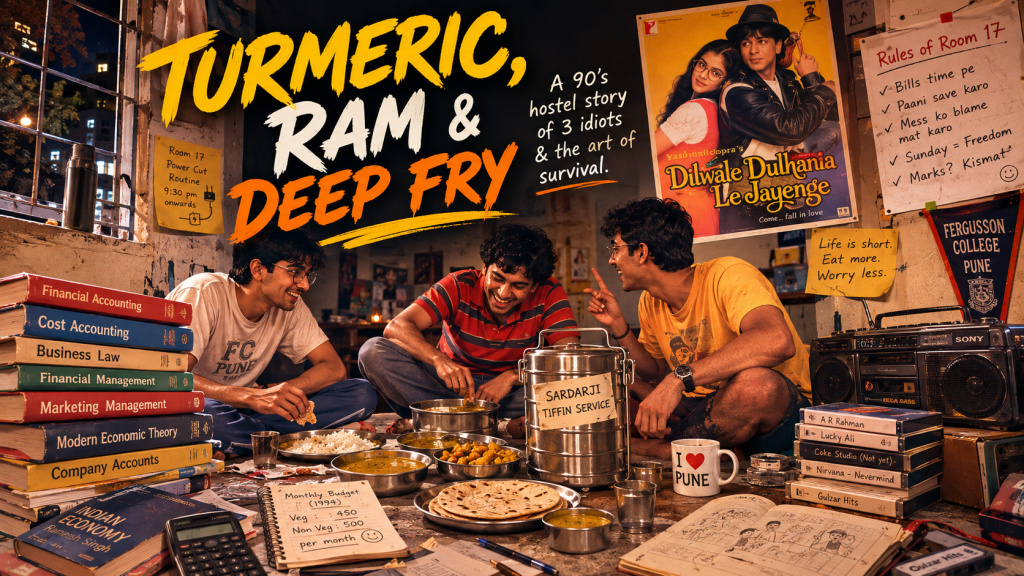
Pune. 1994.
Three students.
One room.
One Maithil.
One Marwari.
One Bengali.
This is not a diversity programme.
This was our hostel room.
Actually, “hostel” is also stretching the definition.
It was called a private hostel.
In the 90s, private didn’t mean premium.
It meant your parents had paid somebody rent for a room and now nobody was responsible for what happened to you.
No CCTV.
No biometric entry.
No WhatsApp group.
No Swiggy.
No Zomato.
No Google Maps.
No UPI.
And most importantly, no photograph of your dinner before you ate it.
You just ate.
Because you were hungry.
And because the alternative was not eating.
₹450
Our dinner came from a Sardarji.
₹450 per month for vegetarian.
₹500 for non-vegetarian.
One meal every evening.
Sunday off.
So roughly 26 dinners.
Which means:
Veg: ₹17.31 per dinner.
Non-veg: ₹19.23.
At ₹17.31, expectations were appropriately calibrated.
Nobody asked:
“Is the paneer organic?”
Nobody wanted to know if the vegetables were locally sourced.
They were sourced.
That itself was sufficient.
Every evening a steel tiffin would arrive.
Rice.
Chapati.
Dal.
Sabzi.
The sabzi had two dominant seasons.
Gawarphalli season.
And Flower season.
For those unfamiliar with 90s Pune English, Flower meant cauliflower.
Nobody called it cauliflower.
Nobody even called it phool gobi.
It was Flower.
“Aaj kya hai?”
“Flower.”
Bas.
Botanical discussion over.
Then twice a week came the big days.
The days we waited for.
The days when life had purpose.
Special dinner.
Vegetarian: Matar Paneer.
Non-vegetarian: Chicken.
Those two days had the emotional importance that Friday evening has for salaried people today.
You came back to the room knowing:
Aaj paneer hai.
Or:
Aaj chicken hai.
Life was good.
Except Sardarji had a dog problem.
The Dog
On some special evenings, Sardarji would personally arrive looking devastated.
Not normal devastated.
Jaspal Bhatti devastated.
The kind of face that immediately told you there had been an unfortunate incident involving food, transportation and destiny.
“O ji…”
We knew something had happened.
“Sardarni ne sab pack kita si…”
Good.
So far so good.
Then came the tragedy.
“Kutta pichhe pai gaya ji.”
Dog chased him.
Scooter slipped.
Tiffin fell.
Terrible accident.
Naturally we were concerned.
“Sardarji, aapko lagi?”
“Nahi ji, main theek haan.”
Thank God.
We took the tiffin upstairs.
Opened it.
Rice.
Perfect.
Chapati.
Perfect.
Dal.
Perfect.
Now the special dabba.
Open.
Matar.
Gravy.
Masala.
Paneer missing.
On chicken day:
Gravy.
Masala.
Oil.
Chicken missing.
This dog was a specialist.
It had absolutely no interest in carbohydrates.
Rice untouched.
Chapati untouched.
Dal untouched.
Even gawarphalli — which frankly I could understand.
But somehow, during a moving scooter accident, this animal could identify the special compartment, open a steel tiffin, remove only the paneer or chicken, reseal the dabba and disappear into the Pune night.
Today we would investigate.
We would check CCTV.
Post on Reddit.
Put a one-star Google review.
“Food okay. Delivery partner repeatedly attacked by protein-selective dog.”
In 1995?
We looked inside the dabba.
Looked at each other.
And said:
Ab kya?
Enter Sethji
This is where our Marwari roommate became useful.
Very useful.
Because Marwaris understand something the rest of us take years to learn.
Never depend completely on the supply chain.
Sethji had inventory.
He walked to his cupboard.
Opened it.
Moved a few things.
And brought out a packet.
His stash.
Emergency food.
The Maithil looked at it.
The Bengali looked at it.
Sethji opened it.
No speech.
No TED Talk.
No motivational quote.
He simply took the rice.
Added dal.
Added the orphaned matar-paneer gravy.
Then took a fistful from the packet and poured it over everything.
Crunch.
Mixed.
Ate.
We followed.
Rice.
Dal.
Matar gravy.
Crunchy sev.
First bite.
Silence.
Second bite.
Then:
“Sethji…”
Pause.
“Maza aa gaya.”
Next chicken disaster?
Same treatment.
Chicken gravy.
Rice.
Dal.
Crunch.
Sorted.
Soon we stopped worrying about Sardarji’s dog.
Maybe dog ate paneer.
Maybe dog ate chicken.
Maybe dog had a gym membership and was on a high-protein diet.
Who cared?
We had Sethji.
And Sethji had his formula.
Whenever the tiffin failed us, he would pull out the packet and declare something that sounded ridiculously profound:
“Haldi. Ram. Deep fry. Sab theek kar dega.”
At nineteen, I thought this was Marwari philosophy.
At fifty-one, I realise it may actually be the secret of life.
You cannot control what arrives in your tiffin.
Sometimes you get paneer.
Sometimes you get chicken.
Sometimes you get only gravy.
Sometimes a mysterious dog apparently eats the best part of your life somewhere between the kitchen and your room.
You can complain.
You can investigate.
You can blame Sardarji.
You can blame the dog.
Or you can take whatever is left, put it on rice, add some crunch and say:
Sethji, maza aa gaya.
And perhaps that is what being really is.
Making the best of what is available.
Which brings me back to where I started.
Turmeric. RAM. Deep fry.
Sounds like Ayurveda, spirituality and Indian cooking, right?
It took me thirty years to realise Sethji had conned us there too.
There was no philosophy.
No turmeric.
No Lord Ram.
No great Indian theory of existence.
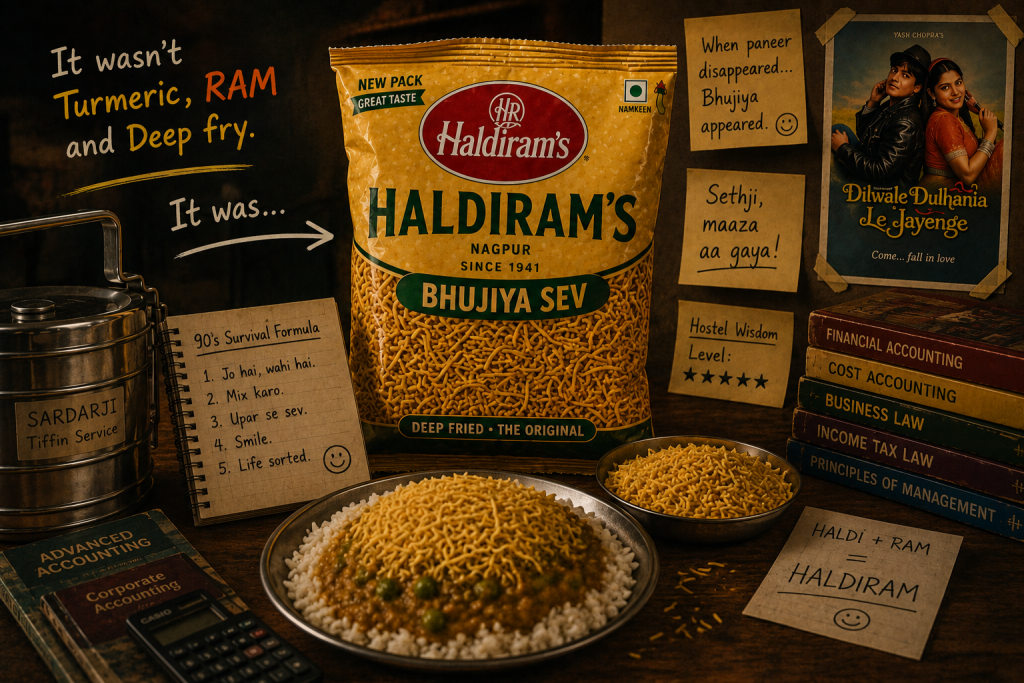
He was just reading the bloody packet in his hand.
Haldiram’s Bhujiya
Bas.
Three idiots had spent three years eating a brand name and thinking Sethji was Osho.
