Where Does Man End and Nature Begin?
My father acquired a bajaj scooter working his ass off, providing for us.
Registration number: BPJ 6543.
I inherited it, which sounds considerably more romantic today than it felt then.
I brought it from Jamshedpur to Pune by Indian Railways. For three years, it was my transport.
Friends had Yamahas.
Suzukis.
Motorcycles that looked fast even when parked.
I had a Bajaj Super.
A perfectly functional, indestructible, middle-class Indian machine whose primary design objective appeared to be ensuring that nobody ever accused its owner of being cool.
Today I would probably pay stupid money to get BPJ 6543 back.
That sentence tells us almost everything that is wrong with human beings.
First, there was Earth
Earth is approximately 4.54 billion years old.
Just hold that number for a moment.
4,540,000,000 years.
Mountains rose.
Continents collided.
Oceans opened and closed.
Species appeared.
Species disappeared.
The Himalayas themselves rose when the Indian tectonic plate collided with Eurasia.
Rivers cut valleys through rock.
Glaciers advanced.
Glaciers retreated.
And for almost all of this extraordinary story—
there was no Bhaskar Thakur.
No Bajaj.
No Yamaha.
No EMI.
No Instagram.
No limited-period offer.
Nature was doing perfectly fine.
Then came us
Modern humans have existed for roughly 300,000 years.
Compared with Earth, we arrived approximately five minutes before closing time.
And immediately started rearranging the furniture.
We discovered fire.
We hunted.
We farmed.
We built settlements.
Then kingdoms.
Then religions.
Then roads.
Then markets.
Then borders.
Then immigration counters.
Eventually someone invented digital marketing.
At which point evolution should perhaps have reconsidered the entire experiment.
But somewhere along this journey, something fascinating happened.
We stopped merely asking:
What do I need?
And began asking:
What do I have compared with him?
That may be one of the most consequential questions our species ever invented.
Enter BPJ 6543
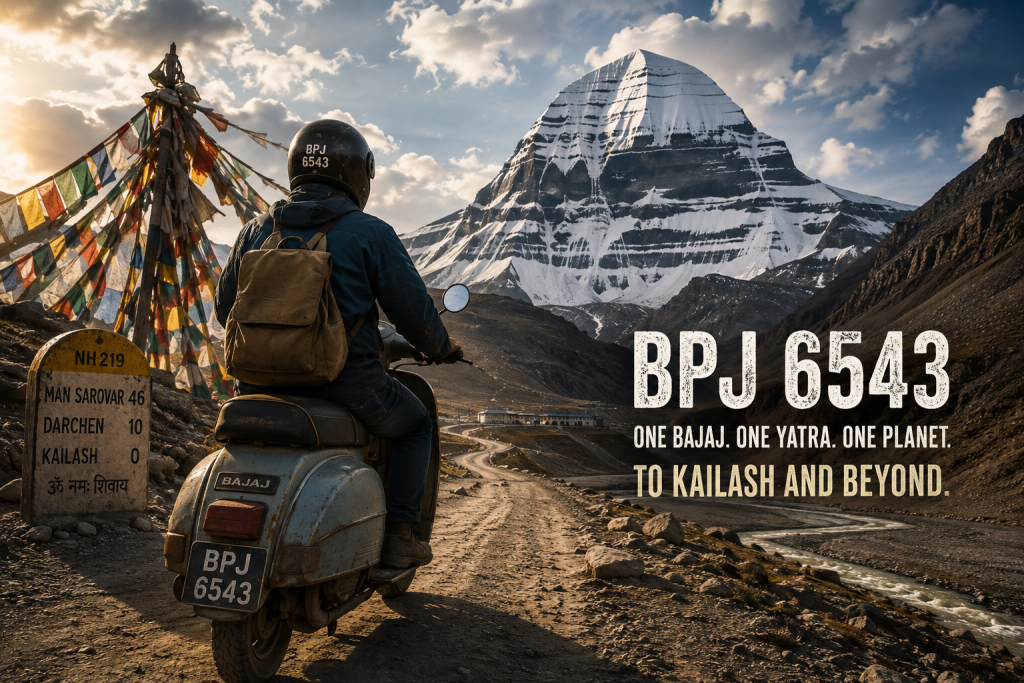
By 1999, I had finished college and had a campus offer from Jasra.
I rejected it.
Not because I had a startup.
The word entrepreneur wasn’t even part of my vocabulary.
I simply thought I had something in me to build a business.
There was confidence.
There was stupidity.
At that age the two are extremely difficult to distinguish.
I decided to move to Delhi.
So BPJ 6543 went back to Jamshedpur.
My family found a buyer.
Somebody paid us some money.
And that was that.
I don’t remember what we sold it for.
But I remember the registration number.
BPJ 6543.
Twenty-seven years later.
Why?
Because somewhere between 1999 and 2026, the value of that scooter changed completely.
Not its market value.
Its value to me.
Which brings me to greed
Greed is an interesting human invention.
Nature doesn’t seem particularly interested in ownership.
A mountain doesn’t own the snow.
A river doesn’t own the water.
A tree doesn’t own the soil.
A glacier doesn’t check whether the valley below has planning permission.
We do.
This is my land.
My house.
My company.
My car.
My phone.
My view.
My country.
My side of the border.
My photograph of Kailash.
We spend an extraordinary portion of our tiny lives drawing lines around things and writing:
MINE.
And then we become unhappy because somebody else’s MINE looks better.
That was my problem with BPJ 6543.
There was nothing wrong with the scooter.
The problem was that someone else had a Yamaha.
The Bajaj carried me exactly where I needed to go.
But I wasn’t measuring transportation.
I was measuring myself.
Then I went to Kailash
Last year I travelled to Mount Kailash.
And I wrote afterwards that we had made the road to Kailash easier.
But had we made the Yatra easier?
For centuries traders crossed those mountains because somebody had salt and somebody else had grain.
Then pilgrims followed.
Then came settlements.
Then roads.
Then bridges.
Then buses.
Then hotels.
Then immigration centres.
Then mobile phones.
Then tour packages.
Then the sixteen-day Kailash itinerary.
Human beings looked at one of the most formidable landscapes on Earth and essentially said:
Can we optimise this?
And remarkably, we did.
Until Nature reminded us of one small contractual detail.
Nature had never agreed to the optimisation.
A glacier doesn’t know there is a road below.
A river doesn’t care that there is an immigration centre beside it.
Gravity has not read the Detailed Project Report.
The mountain has not approved our itinerary.
That was what the Nepal–Tibet tragedy brought home so brutally.
We built roads through ancient valleys.
We put bridges across rivers.
We built settlements along trade corridors.
We transported thousands of people through landscapes created over geological time.
And then, in a few minutes, water, ice, rock and gravity demonstrated the difference between access and control.
4.54 billion years versus 51
That ratio has been bothering me.
Earth:
4,540,000,000 years.
Me:
51 years.
And within those 51 years I have managed to worry about:
Which scooter I rode.
Which car I drove.
Which phone I owned.
Whether someone had a better one.
Whether my business was bigger.
Whether I ran faster.
Whether I got the photograph.
Whether somebody liked the photograph.
Whether the Wi-Fi at 4,600 metres was working.
The mountain has existed through epochs.
I stood in front of it for a few minutes and wanted a good photograph.
There is something magnificently stupid about Homo sapiens.
Perhaps faith understood this before business did
Faith, in its oldest form, may have been our attempt to understand forces vastly larger than ourselves.
The sun.
The rain.
Death.
Birth.
Mountains.
Rivers.
Thunder.
The unknown.
We stood before things we couldn’t control and felt awe.
Then human intelligence did what human intelligence does.
We learned.
We engineered.
We predicted.
We built.
And slowly the relationship changed.
From:
Nature is larger than me.
to:
Nature is a resource for me.
The mountain became real estate.
The river became megawatts.
The forest became timber.
The coastline became a resort.
The pilgrim route became a tourism product.
And somewhere in that transformation, perhaps we confused the ability to use nature with the ability to control nature.
Man vs Nature
We even call it that.
Man versus Nature.
What an extraordinary phrase.
As though there are two teams.
Humans on one side.
Nature on the other.
But what exactly are we fighting?
We are carbon, water, calcium, bacteria and electricity walking around temporarily in a particular arrangement.
We eat nature.
Drink nature.
Breathe nature.
Eventually we return every atom we borrowed.
There isn’t really Man vs Nature.
There is only nature—
and a very small part of nature that recently developed consciousness and immediately became convinced it was the Managing Director.
So where is the boundary of self?
That is what BPJ 6543 makes me wonder about.
At 24, my self extended to the machine I was riding.
Someone else’s Yamaha somehow made me smaller.
Today that Bajaj means something completely different.
My father rode it.
I rode it.
Indian Railways carried it across the country.
It travelled through one small part of my life.
Then somebody else bought it.
Perhaps it was scrapped years ago.
Perhaps some part of BPJ 6543 was melted down and became something else.
Perhaps somewhere in India there is a piece of metal that once carried my father and me and today has absolutely no idea that I am writing about it.
Which is probably the correct perspective.
Because nothing was ever really mine.
Not the Bajaj.
Not the road.
Not the mountain.
Not even this body.
I am borrowing all of them.
We are very new here
Earth has been here for about 4.54 billion years.
Life for billions.
Humans for a few hundred thousand.
Civilisations for a few thousand.
Industrialisation for a couple of centuries.
Modern consumer culture for considerably less.
And I have been here for 51.
Yet somehow, in that microscopic window, we have convinced ourselves that the planet is organised around our requirements.
Road required.
Build it.
River in the way.
Bridge it.
Mountain in the way.
Tunnel it.
Forest in the way.
Clear it.
Want to reach Kailash?
Package it.
Want a better motorcycle?
Finance it.
Want happiness?
There will be an app for that too.
And every once in a while the planet does something that reminds us:
You are not the customer.
I once thought BPJ 6543 wasn’t good enough for me.
Today I would love to see it once again.
Maybe growing older is partly discovering how many things we misunderstood because we were looking at them through the tiny boundary of me.
And maybe Kailash was trying to tell me the same thing.
I had written:
Kailash doesn’t need my Pixel.Kailash doesn’t need my captions.Kailash doesn’t even need me.I needed Kailash.
After what happened in Nepal, I would add one more line.
Nature doesn’t need us either.
We need nature.
We have always needed nature.
We just became successful enough to forget it.
For about 4.54 billion years, this planet existed without BPJ 6543.
For almost all of that time, it existed without us.
That should tell us something about who is dependent on whom.
We didn’t conquer nature.
We just got a little too comfortable riding through it.
