New Delhi, July 2026.
I’m not sure the readers have heard this song:
India has always believed in matching the solution to the problem.
Mosquitoes?
Good Knight.
Cockroaches?
HIT.
Students dressed as cockroaches?
Apparently, somebody may have taken the branding a little too literally.
Thousands of young Indians associated with the Cockroach Janta Party (CJP) took to the streets of Delhi this week, protesting over examination failures, alleged paper leaks and accountability in the education system.
What began as satire had become a serious youth movement.
And then came the police.
Tear gas.
Batons.
Barricades.
Detentions.
And some extraordinary videos from the streets of the world’s largest democracy.
Reuters reported that thousands participated in demonstrations and that clashes in Delhi left around 180 protesters and police personnel injured, while police used tear gas and batons as protesters attempted to march towards Parliament.
Associated Press also reported police using tear gas and batons to stop protesters moving towards Parliament.
The images and videos circulating from Delhi showed something wonderfully absurd and deeply uncomfortable:
Young Indians had voluntarily dressed themselves as cockroaches.
And somewhere along the way, crowd management appeared to resemble pest control.
From Student to Cockroach: A Career Progression
The Cockroach movement reportedly emerged after unemployed young people were compared to “cockroaches”—an insult protesters subsequently appropriated as their symbol.
Instead of being offended, Gen Z did what Gen Z does best.
They turned it into a meme.
Then a costume.
Then a movement.
Associated Press describes the movement as youth-driven and rooted in anger over examination problems, employment anxiety and demands for accountability.
There is something uniquely Indian about this evolution.
Earlier generations protested carrying flags.
The next generation carried placards.
Gen Z arrived dressed as insects.
And suddenly the State faced an unprecedented administrative challenge:
Which department handles this?
Education Ministry?
Home Ministry?
Municipal Pest Control?
Enter: HIT
For readers unfamiliar with Indian household warfare, Lal HIT is a famous cockroach-killing spray.

Its manufacturer describes it as a product designed to get rid of cockroaches.
Its marketing language famously revolves around reaching cockroaches hiding in difficult corners.
Which makes the events in Delhi an unfortunate case of life imitating advertising.
Students called themselves cockroaches.
They came out onto the streets.
And the authorities appeared determined to ensure they went back into the cracks.
Metaphorically speaking, of course.
Because the police did not actually use HIT.
They used something considerably more traditional.
Lathi.
India: where technology may change, but some user interfaces remain reassuringly familiar.
Except There Is a Small Problem Called the Constitution
Before anyone reaches for another aerosol can, India has this inconvenient document called the Constitution.
Article 19(1)(a) protects:
Freedom of speech and expression.
Article 19(1)(b) protects:
The right to assemble peaceably and without arms.
These rights are not absolute. The State can impose reasonable restrictions in the interests of public order and other constitutionally recognised grounds.
Which means:
You have a right to protest.
The State has a right to regulate the protest.
But neither side receives an unlimited “Do Whatever You Want” coupon.
This distinction becomes important when a protest turns confrontational.
Because the law does not simply say:
Crowd detected.
Apply lathi.
There is actually a process.
The Government Has Its Own Instruction Manual
The relevant law today is the Bharatiya Nagarik Suraksha Sanhita, 2023 — BNSS. The interesting section is Section 148: Dispersal of assembly by use of civil force.
It allows an Executive Magistrate or specified police officer to order an unlawful assembly—or an assembly of five or more persons likely to disturb public peace—to disperse.
And if the assembly does not disperse, the law permits necessary civil force to disperse it.
Notice the sequence.
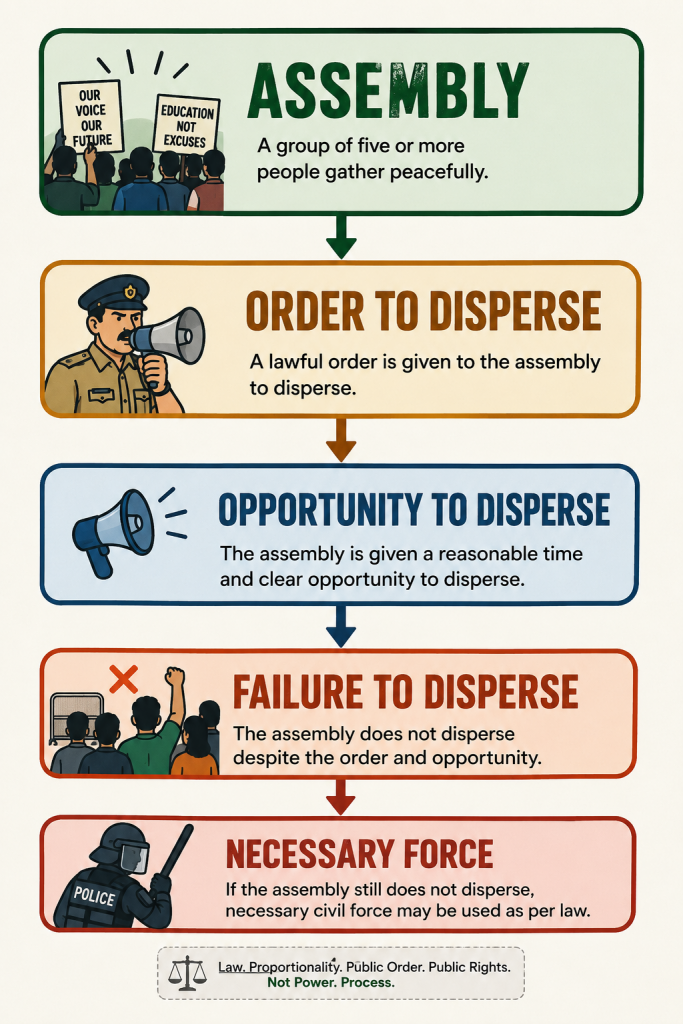
This is slightly different from:
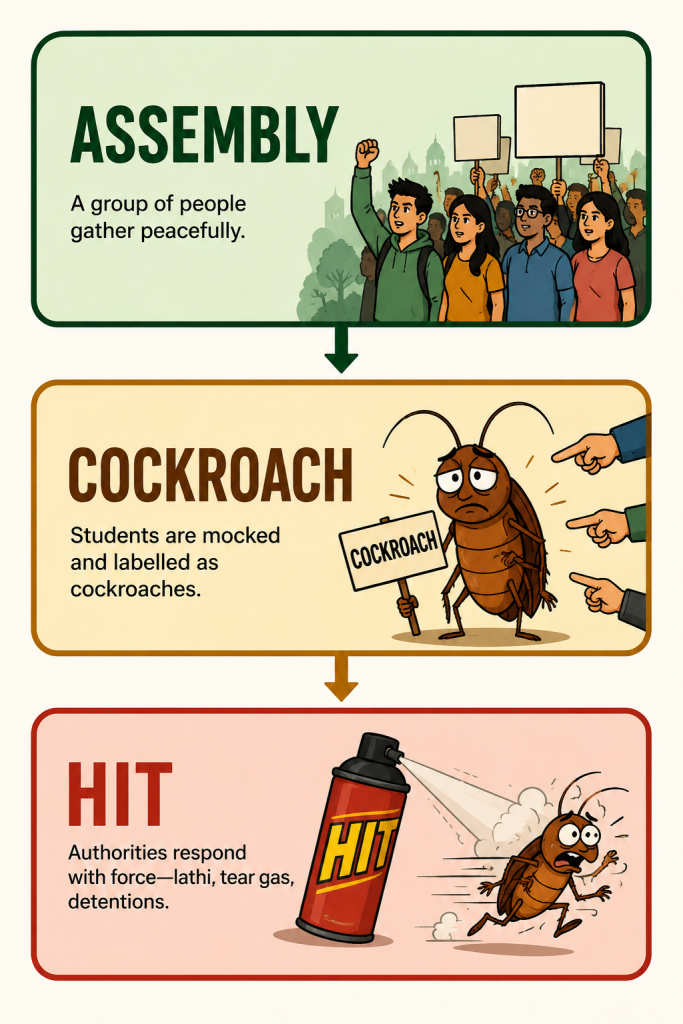
The distinction may appear bureaucratic.
It is actually constitutional.
Rule No. 1: First, Decide Whether You Have Protesters or Rioters
A crowd is not automatically a riot.
A protester shouting slogans is not automatically violent.
A person crossing a barricade is not automatically equivalent to someone throwing stones.
And someone standing nearby filming everything on an iPhone is definitely not automatically the mastermind.
Crowd-control doctrine therefore requires something increasingly rare in public debate:
distinction.
Peaceful protesters.
Agitated protesters.
People breaching barricades.
People attacking police.
People damaging property.
People trying to leave.
These categories matter.
Because policing everyone as though they belong to the most violent category is not crowd management.
It is crowd generalisation.
The Bureau of Police Research & Development—India’s own police research and training institution—has published extensive material on crowd control and the calibrated use of force.
BPR&D materials describe riot-control contingents and recognise a sequence in the use of force, rather than treating every crowd-control option as interchangeable.
In other words:
Even the police manual does not say:
“Shake can well before use.”
Rule No. 2: Minimum Force Is Not a Suggestion
Police have an exceptionally difficult job during mass protests.
That needs to be acknowledged.
A peaceful crowd can change quickly.
Barricades can collapse.
A few people can throw stones.
Officers can be injured.
Panic can spread faster than WhatsApp misinformation.
On July 20, Reuters reported injuries among both protesters and police, which matters when assessing what actually happened.
That is precisely why the legal principle is not:
Never use force.
It is:
Use only the force that is necessary and proportionate to the threat.
India’s own BPR&D policing literature emphasises the need for minimum force.
The difficult question, therefore, is not:
“Did police have the power to use force?”
They may have.
The better questions are:
Against whom?
At what moment?
For what conduct?
After what warning?
At what level?
And did the force stop when the threat stopped?
Those questions are considerably less entertaining than a viral video.
But considerably more important.
Rule No. 3: Please Leave an Exit Before Asking People to Exit
Imagine this.
Police barricade Road A.
Police barricade Road B.
Police close Road C.
Then announce:
“DISPERSE IMMEDIATELY.”
Crowd:
“Excellent suggestion. Kindly share Google Maps link.”
This sounds like satire.
It is actually a serious crowd-management issue.
A dispersal order only works if people can actually disperse.
Large crowds need:
clear instructions,
audible warnings,
reasonable time,
and safe exit routes.
Otherwise:
“Disperse!”
becomes less of an instruction and more of a philosophical question.
The Supreme Court Has Seen This Movie Before
In 2011, police cleared protesters from Delhi’s Ramlila Maidan during the night.
The incident eventually reached the Supreme Court.
In Re: Ramlila Maidan Incident v. Home Secretary, Union of India
The Court examined the balance between maintaining public order and protecting constitutional freedoms.
The case became an important reference point for the principle that State restrictions and police action cannot be arbitrary or excessive merely because authorities possess statutory powers.
The Supreme Court revisited these principles in later judgments, including Anuradha Bhasin v. Union of India.
The principle can be translated into simple Indian:
Having a lathi and having a legal reason to use the lathi are not the same thing.
Jantar Mantar Has Also Been to the Supreme Court
Another important judgment is:
Mazdoor Kisan Shakti Sangathan v. Union of India(2018)
The case dealt directly with demonstrations around Jantar Mantar.
The Supreme Court recognised something surprisingly sensible:
Protesters have rights.
Residents have rights.
Commuters have rights.
The State has a duty to balance them.
The answer therefore is not always:
BAN EVERYTHING.
Nor is it:
LET EVERYONE MARCH ANYWHERE.
It is something far more difficult.
Management.
Routes.
Timings.
Buffer zones.
Barricades.
Negotiation.
Controlled access.
Safe dispersal.
Targeted action against actual offenders.
Unfortunately, good crowd management rarely goes viral.
A policeman calmly negotiating with organisers gets 327 views.
A policeman swinging a lathi gets 32 million.
The algorithm has spoken.
The Most Important Question: Who Was Doing What When Force Was Used?
Videos from protests are powerful.
They are also fragments.
A 12-second clip may show a policeman striking a student.
It may not show what happened 30 seconds earlier.
Similarly, a government statement may say protesters turned violent.
It may not establish that every person subsequently struck was violent.
So the correct way to examine the CJP confrontation is not:
POLICE BAD.
or
PROTESTERS BAD.
It is:
Timeline. Evidence. Conduct. Response. Proportionality.
For every significant video, ask:
- What were protesters doing immediately before force was used?
- Was there a lawful dispersal order?
- Could people hear it?
- Were they given time to comply?
- Was an exit available?
- Were individuals attacking police or damaging property?
- Was force directed at those individuals—or generally at everyone nearby?
- Did police escalate gradually where circumstances allowed?
- Did force continue against people retreating or already under control?
- Were injured protesters and police given prompt medical assistance?
That is how a democracy should investigate crowd control.
Not by counting which hashtag has more retweets.
Perhaps We Need a New Product
Maybe India needs a new version of HIT.
Not Lal HIT.
Loktantra HIT.
Instructions:
Step 1: Spray dialogue.
Step 2: Apply negotiation generously.
Step 3: Use barricades only where required.
Step 4: Clearly communicate lawful restrictions.
Step 5: Give people somewhere to disperse.
Step 6: Isolate actual violence.
Step 7: Use minimum necessary force only when required.
Possible side effects:
Accountability.
De-escalation.
Fewer hospital visits.
And, in extreme cases,
democracy.
Because Cockroaches Are Difficult Creatures
There is one final problem with calling young people cockroaches.
Cockroaches are famously resilient.
You spray them.
They disappear.
You assume the problem has been solved.
Then at 2 a.m., you switch on the kitchen light.
They are back.
Perhaps there is a lesson here.
You can barricade students.
You can detain them.
You can disperse a march.
You can argue that the route was unauthorised.
You can investigate those who committed violence.
And where legally necessary, the State absolutely should maintain public order.
But unemployment does not disappear after a lathi charge.
Exam leaks do not disappear behind barricades.
Student anxiety does not disperse because the crowd dispersed.
Those problems crawl back out.
Usually when the lights come on.
So perhaps the most important question after Delhi is not:
Who ordered the HIT?
It is:
Why were there so many cockroaches in the kitchen in the first place?
Sources & further reading
Current reporting
Reuters — Thousands protest in India after clashes; injuries reported among protesters and police
https://www.reuters.com/world/india/india-youth-group-says-protest-continue-after-delhi-clashes-injure-180-2026-07-21/
Reuters — Cockroach movement protests and talks
https://www.reuters.com/world/india/indias-cockroach-movement-supporters-gather-march-despite-police-ban-2026-07-20/
Associated Press — Police use tear gas and batons to stop march toward Parliament
https://apnews.com/article/cbeb4773e89d67250f0bcad1670fcd38
Associated Press — Background to India’s Cockroach protest movement
https://apnews.com/article/59d045fbd485635def01b01f3898307b
Law and policing
India Code — Bharatiya Nagarik Suraksha Sanhita, 2023, Sections 148–151
https://www.indiacode.nic.in/handle/123456789/20099
India Code — Section 148: Dispersal of assembly by use of civil force
https://www.indiacode.nic.in/show-data?actid=AC_CEN_5_23_00049_202346_1719552320687&orderno=148
Supreme Court of India — Mazdoor Kisan Shakti Sangathan v. Union of India (2018)
https://api.sci.gov.in/supremecourt/2017/37006/37006_2017_Judgement_23-Jul-2018.pdf
Supreme Court of India — Anuradha Bhasin v. Union of India (2020), discussing Ramlila Maidan and limits on preventive restrictions
https://api.sci.gov.in/supremecourt/2019/28817/28817_2019_2_1501_19350_Judgement_10-Jan-2020.pdf
Bureau of Police Research & Development — Police and crowd-control reference material
https://bprd.nic.in/uploads/pdf/1645442204-Volume%201.pdf
For identification purposes only: the other HIT
Godrej HIT — Official product page
https://www.godrejhit.com/products/lal-hit
Note: “Authorities used HIT” is satire. Reports cited above describe police use of tear gas and batons, not insecticide. Accounts of individual incidents and viral videos should be assessed against complete footage, official records and independent reporting before attributing unlawful conduct to any individual officer or protester.
