There was a time when choosing your goal marathon was easy. The Indian running calendar had only a handful of full marathons, and your decision was usually based on one simple question—which city am I travelling to this year? Today, that’s a luxury problem of the past. Every weekend seems to offer multiple well-organised races, and it’s not uncommon to find two excellent marathons scheduled on the very same day. Runners are spoilt for choice—and often overwhelmed by data. Course maps, elevation charts, weather forecasts, YouTube reviews, Strava segments, Reddit opinions… the more information available, the harder the decision becomes.
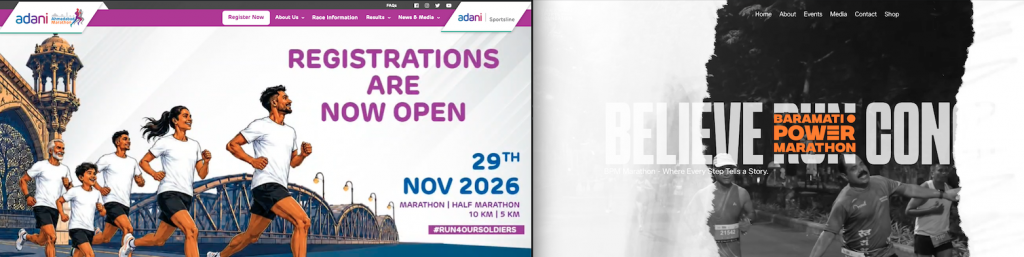
This year presents one such dilemma. The Adani Ahmedabad Marathon and the Baramati Power Marathon are both scheduled on 29 November. Both are exceptionally well-organised events with loyal followings, enthusiastic volunteers and excellent race-day experiences. Both courses have produced countless personal bests for recreational runners over the years. So, if either race is capable of delivering a PB, how do you choose between them?
Is one course genuinely faster than the other? Does the similar-looking elevation profile tell the whole story? Should you prefer an out-and-back route over a two-loop course? Do bridge climbs cost more than rolling hills, or do the downhills give enough back to even the score?
To answer those questions, I compared the actual GPX files of both marathons—not just the published elevation charts—to understand what the courses really demand from a recreational marathon runner targeting anywhere between 3:00 and 4:30 hours.
The answer, as it turns out, is far more interesting than simply comparing total elevation gain.
“It’s only 20 metres more climbing.”
That’s probably the most misleading statement a marathon runner can hear.
When runners compare marathon courses, they usually look at one number—total elevation gain. Ahmedabad gains around 244 m, while Baramati gains around 226 m. At first glance, they appear almost identical.
But marathons are not run on spreadsheets.
A marathon is a sequence of thousands of strides, each affected by where the climbs occur, how long they last, how quickly you recover, how often you lose rhythm, and what the course asks of you after 30 km.
Using the GPX files of both races rather than the simplified elevation charts published online, here’s what the two courses really look like.
The Numbers
| Metric | Ahmedabad | Baramati |
|---|---|---|
| Distance | 42.20 km | 42.20 km |
| Total Ascent | ~244 m | ~226 m |
| Course Type | Out-and-back | Two 21.1 km loops |
| Character | Frequent bridge rollers | Sustained rolling terrain |
On paper, the two courses are remarkably similar.
On the road, they feel completely different.
Elevation Gain Isn’t the Whole Story
Imagine climbing twenty floors in a building.
Now imagine climbing twenty separate flights of one floor each, with a chance to rest between every flight.
The total climb is identical.
The effort isn’t.
That’s exactly how these two marathon courses differ.
Ahmedabad – Death by a Thousand Bridges
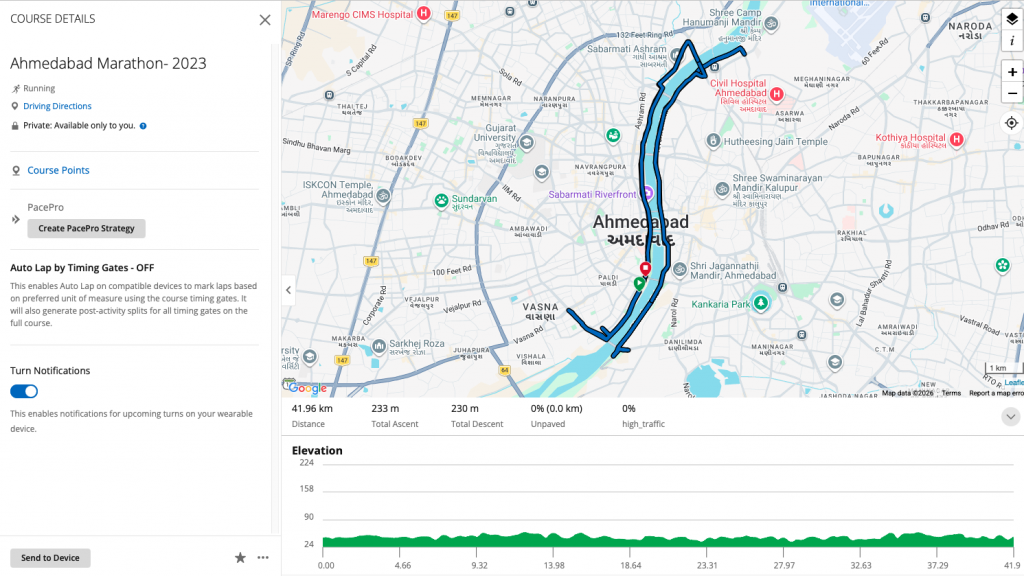
Adani Ahmedabad’s elevation comes largely from bridge approaches.
The biggest climbs in the GPX are:
| Approx. Location | Length | Climb |
|---|---|---|
| 6.8 km | 500 m | 11.8 m |
| 13.5 km | 450 m | 11.7 m |
| 15 km | 735 m | 13.6 m |
| 34 km | 700 m | 14.9 m |
Notice the pattern.
None of these climbs is particularly long.
Each climb is immediately followed by its descent.
Instead of one sustained hill, Ahmedabad keeps asking the same question:
“Can you stay patient for another 500 metres?”
Then it rewards you with an equally short downhill.
Baramati – The Roller Coaster
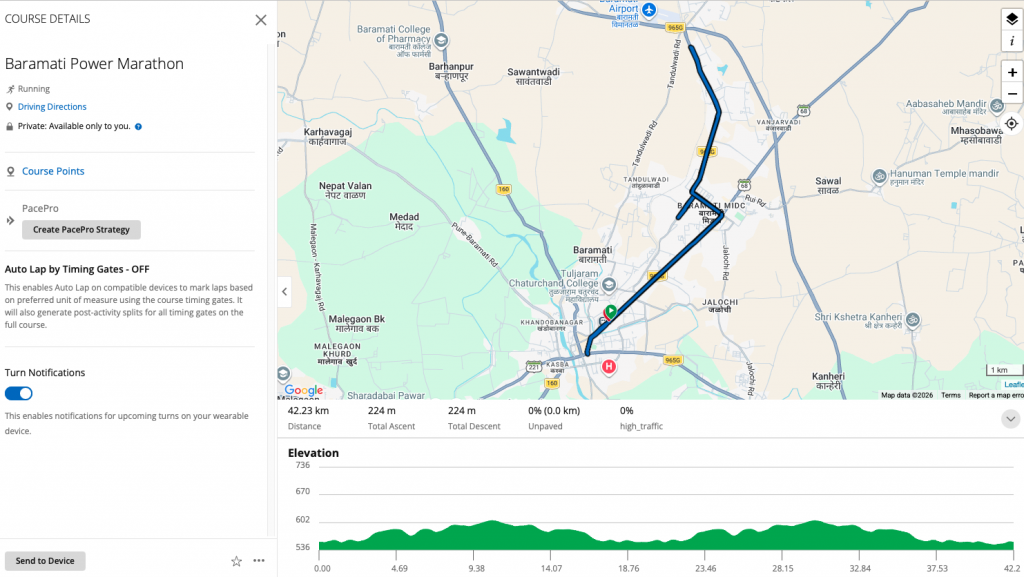
Baramati gains almost the same elevation, but distributes it very differently.
Largest climbs include:
| Approx. Location | Length | Climb |
|---|---|---|
| 2.5 km | 1.07 km | 20.2 m |
| 9.1 km | 730 m | 9.2 m |
| 22.6 km | 500 m | 12.7 m |
| 25.6 km | 490 m | 9.5 m |
| 27.1 km | 550 m | 11.2 m |
These are not bridge ramps.
They’re longer, sustained rollers.
Instead of repeatedly changing gears, Baramati asks you to settle into an uphill effort for several hundred metres before releasing you onto an equally meaningful descent.
The Downhill Matters Too
This is where most elevation comparisons stop—and where they become incomplete.
Climbing costs energy.
Descending can give some of it back.
The way each course distributes those descents makes a significant difference.
Ahmedabad
Because the course is essentially out-and-back with repeated bridge crossings, every uphill is followed almost immediately by a downhill.
That has several advantages:
- Heart rate drops quickly.
- Lactate accumulation stays under control.
- The downhill is short enough that it causes minimal eccentric muscle damage.
- You regain rhythm almost immediately.
The downside?
You never get to use gravity for very long.
The downhill is over before you’ve fully settled into it.
Baramati
Baramati’s longer descents tell a different story.
After every sustained climb comes a longer opportunity to relax, lengthen the stride slightly, lower the heart rate and recover without walking.
For experienced runners, these descents aren’t simply “free speed.”
They’re free recovery.
That becomes increasingly valuable after halfway.
Where the Hills Occur Matters More Than How Many There Are
A five-metre climb at 5 km and a five-metre climb at 37 km have the same elevation.
They do not have the same cost.
Ahmedabad
The bridge rollers are distributed fairly evenly throughout the race.
There are still bridge crossings in the final 8 km, but none are especially long or steep.
The course continually interrupts your rhythm—but never for very long.
Baramati
The more demanding rolling terrain appears in the latter part of each loop.
On the second lap, this corresponds roughly to the marathon’s decisive kilometres.
Initially, this appears to be a disadvantage.
However, the profile also provides meaningful descents after those climbs.
Instead of climbing continuously into the finish, runners get opportunities to recover and regain momentum.
This is one reason the course often feels easier than its elevation profile suggests.
Rhythm vs Recovery
This is perhaps the biggest difference between the two races.
Ahmedabad rewards rhythm.
Baramati rewards effort management.
Ahmedabad
A typical bridge might look like this:
- 300–700 m uphill
- immediate 300–700 m downhill
- back to marathon pace
Your watch barely has time to complain.
Baramati
A typical roller looks more like:
- 700–1000 m climbing
- 700–1000 m descending
You spend longer climbing.
But you also spend longer recovering.
The result is a very different running experience.
Turns and Course Flow
Course rhythm isn’t influenced only by elevation.
It also depends on how often you’re forced to slow down.
Ahmedabad
The riverfront roads are long and wide.
There are relatively few sharp turns.
It’s easy to settle into a marathon rhythm and stay there.
Baramati
Being a loop through town and surrounding roads, Baramati naturally has more intersections and direction changes.
Nothing excessive—but enough to make the course feel more dynamic.
Some runners enjoy this variety.
Others prefer the uninterrupted rhythm of Ahmedabad.
Weather
Late November usually favours both races.
Ahmedabad
- Slightly warmer start
- Dry conditions
- Moderate humidity
- Temperatures rise steadily after sunrise
Baramati
- Cooler morning temperatures
- Lower humidity
- More open roads, with a greater chance of encountering wind
Weather alone slightly favours Baramati, although yearly conditions can vary.
Which Course Is Actually Faster?
There isn’t a universal answer.
The answer depends on what kind of runner you are.
Ahmedabad suits runners who:
- Prefer locking into one pace.
- Enjoy consistent rhythm.
- Like courses that never become particularly difficult.
- Want predictable pacing from start to finish.
Baramati suits runners who:
- Run by effort rather than pace.
- Are comfortable on rolling terrain.
- Know how to stay relaxed on descents.
- Can use downhill sections as active recovery instead of simply running faster.
Final Verdict
Looking only at total elevation, the two races appear almost identical.
Looking at the GPX files tells a richer story.
Ahmedabad spreads its climbing across dozens of short bridge ramps that barely interrupt the race before giving the elevation back almost immediately.
Baramati concentrates its elevation into longer rollers but also gives runners longer descents—opportunities to recover, regain rhythm and let gravity do a little of the work.
Neither course is objectively “harder.”
They simply ask different questions.
Ahmedabad asks:
Can you maintain the same rhythm for 42 kilometres?
Baramati asks:
Can you manage your effort intelligently over rolling terrain?
For experienced recreational marathoners targeting anywhere between 3:00 and 4:30, both courses are capable of producing excellent performances. The decision is less about total elevation and more about understanding how you naturally run.
Sometimes the fastest marathon isn’t the flattest one.
It’s the one that matches your running style.

Very well analysed, Bhaskar. 👏 The comparison goes beyond just total elevation and rightly looks at where the climbs occur, their length, and how they affect the second half of the marathon.
As a coach, I would add that elevation is only one part of the equation—effort management, heart rate and the ability to recover your rhythm after a climb often matter even more.
A very useful and practical comparison for runners. Well done! 👏
Thank You! Satish Gujaran Anna! Which one are you running?