Every marathon block has one week that quietly changes the direction of the campaign. It doesn’t produce a personal best. It doesn’t make Strava headlines. It simply lays another brick in the foundation.
Week 5 was that week.
After the niggle in Week 3 and the controlled return in Week 4, the objective was simple: get back to consistent training while increasing volume without compromising recovery. There was no temptation to “make up” missed mileage. The focus remained on trusting the process.
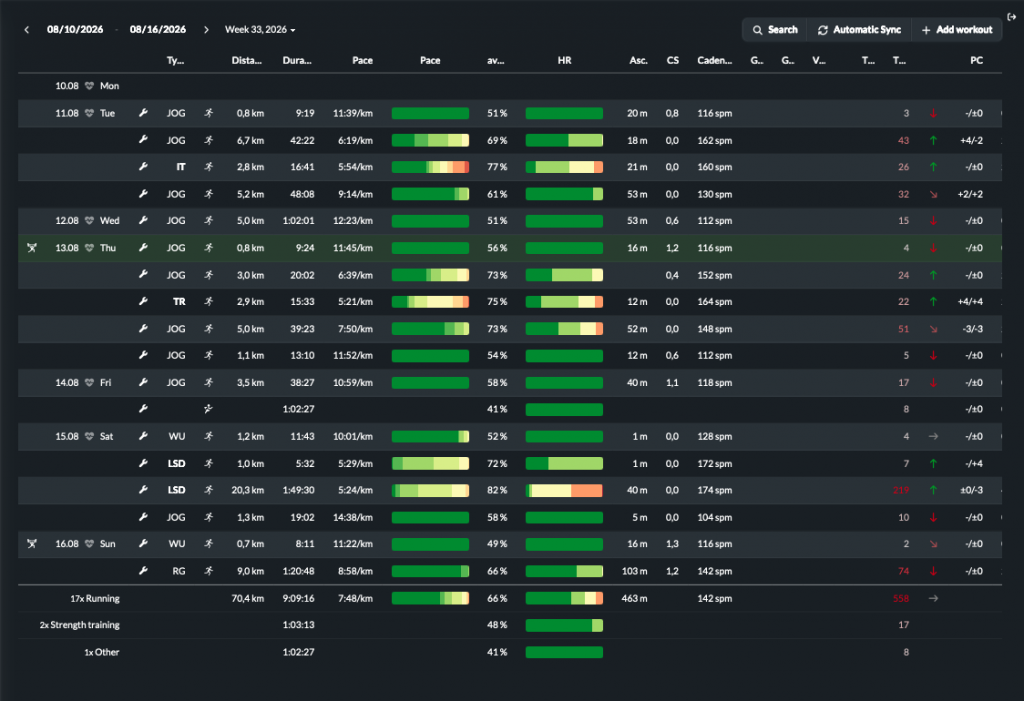
The Week at a Glance
- Total Running: 70.4 km
- Time on Feet: 9 hr 9 min
- Running Sessions: 17 (including warm-ups/cool-downs)
- Strength Training: 2 sessions
- Other Training: 1 Yoga session
- Elevation: 463 m
The volume moved back to where it needed to be, and more importantly, the body handled it well.
Tuesday – Threshold Returns
The week began with a threshold workout that was more about rhythm than speed.
The session consisted of:
- Warm-up
- Aerobic running
- 2.8 km of Threshold work
- Easy cooldown
Rather than chasing a target pace, I ran by feel, allowing heart rate and effort to dictate the session. That’s one of the biggest advantages of training using Lactate Threshold Heart Rate (LTHR) instead of blindly following pace. Weather, terrain and fatigue all influence pace, but the body always tells the truth.
The threshold effort felt controlled—not easy, but sustainable—which is exactly where it should be at this stage of the marathon build.
Wednesday & Friday – Recovery Takes Different Forms
Marathon training isn’t just about running more kilometres; it’s about recovering well enough to absorb them.
Wednesday’s easy recovery run kept the legs moving and encouraged blood flow after Tuesday’s threshold session.
Friday, instead of another run, was dedicated to Angamardana, the practice designed to build strength, flexibility, balance and resilience using only the body. As the weekly training load increases, maintaining mobility and structural strength becomes just as important as building aerobic fitness.
I’ve begun to appreciate that recovery isn’t always passive. Sometimes the best preparation for a long run isn’t another few kilometres on tired legs, but an hour spent improving movement quality, enhancing body awareness and allowing the muscles to reset.
Marathon fitness is built during hard sessions. Marathon longevity is built during recovery.
Thursday – Tempo with a Purpose
Thursday brought another quality session.
After an easy warm-up and aerobic running, I settled into a 2.9 km Tempo Run before cooling down.
The pace was comfortably hard—right where marathon-specific fitness begins to develop.
These shorter tempo efforts are gradually teaching the body to become economical at faster speeds before the longer marathon pace sessions begin dominating the schedule later in the block.
The effort felt smoother than it did a few weeks ago, an encouraging sign that the aerobic engine continues to improve.
Saturday – The Long Run
The highlight of the week was the long run.
After warming up, the session included over 20 km of continuous running, taking the day’s total beyond 22 km.
The objective wasn’t speed.
The objective was endurance.
Staying relaxed, keeping the heart rate under control and learning to run efficiently on tired legs are far more valuable than forcing a faster pace at this point in the programme.
Every long run is another rehearsal for Ahmedabad.
Every kilometre teaches the body to become a little more efficient.
Sunday – Running on Tired Legs
Sunday’s recovery run came after the longest run of the week.
Nine easy kilometres on fatigued legs reminded me that marathon training isn’t just about the long run—it’s about learning to run well the day after.
There was no hero pace.
Just steady aerobic running, allowing the body to absorb the week’s work.
Those recovery kilometres often become the difference between merely finishing a marathon and racing one well.
What Changed This Week?
Looking back over the first five weeks, a few encouraging trends are becoming clear:
- The training volume is steadily increasing without aggravating the earlier niggle.
- Threshold sessions are feeling more controlled and repeatable.
- Recovery between key workouts is improving.
- Long runs are becoming routine rather than intimidating.
- Confidence is quietly replacing uncertainty.
Perhaps the biggest win wasn’t visible on the watch.
It was consistency.
Looking Ahead
The real marathon work is still to come.
Longer marathon pace blocks.
More demanding threshold sessions.
Higher weekly mileage.
The temptation is always to think the fitness arrives after one spectacular workout.
In reality, it arrives after weeks exactly like this one.
Week 5 wasn’t about proving fitness.
It was about earning the right to train harder in the weeks ahead.
And that is exactly what marathon training is supposed to do.
The engine is getting stronger.
Now the real build begins.

You are doing great. I have a feeling this block will result in good output. Especially as you have incorporated mobility and strength focused days.