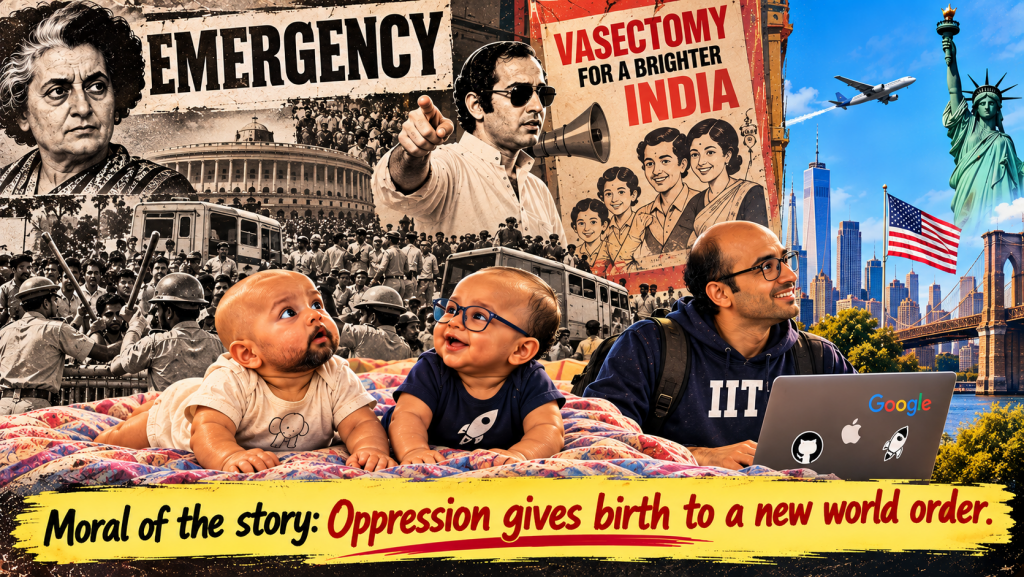
I was born 73 days before Emergency was decleared in India ( Thankfully, it was no emergency for my mother, I had a natural birth).
My first and second birthdays were “Emergencies”.
During this time there was a mass campaign for Vasectomy.
Miraculously! 70 days after the Emergency, my younger brother was born, who grew up to be a super intelligent American citizen.
Moral of the story, Oppression gives birth to a new world order.
Now, let’s move forward many generations identified by greek symbols..
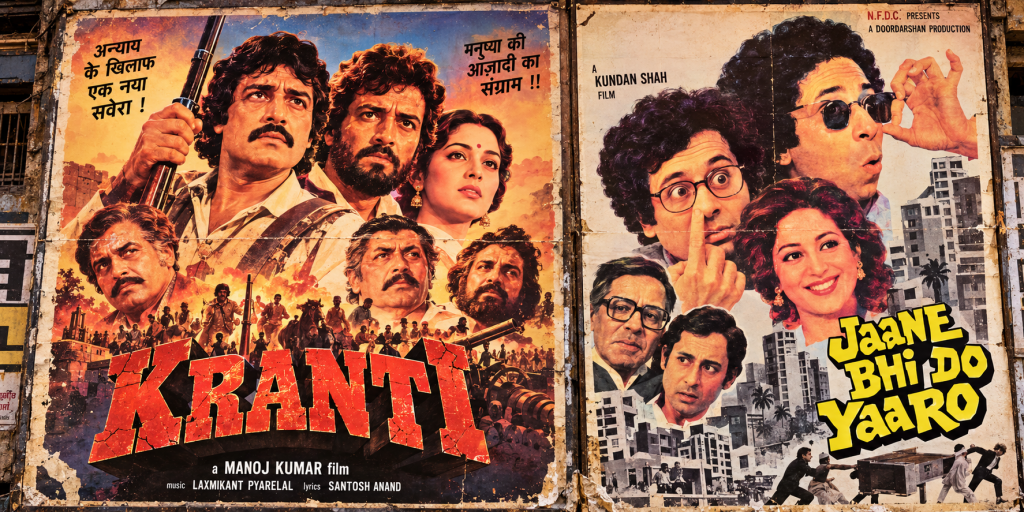
Yesterday, October 10, 2026, I watched two movies.
Kranti.
And Jaane Bhi Do Yaaro.
Bad idea.
Because somewhere between Manoj Kumar staring patriotically into the distance and D’Mello refusing to stay dead, I realised that Indian public life may have changed its technology, vocabulary and hashtags.
But the screenplay?
Wohi hai.
Picture abhi 1981 ki hai
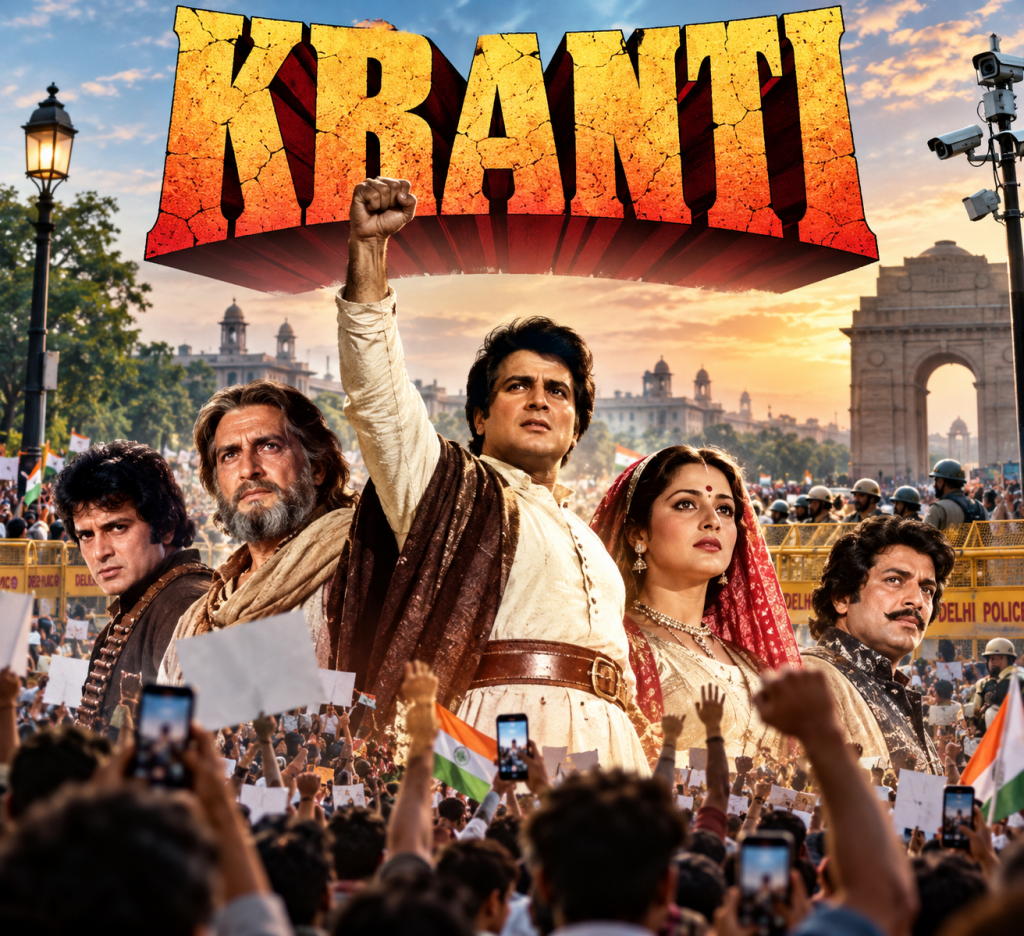
Kranti has everything a proper revolution requires.
There is an oppressor.
There are the oppressed.
There is injustice.
There is anger.
And eventually, there is Kranti.
The oppressor has one simple management philosophy:
Control the people and you control the problem.
Unfortunately, oppressed people have historically been rather poor at reading management PowerPoints.
You arrest one.
Ten get angry.
You stop ten.
Hundred become curious.
You ban the meeting.
Suddenly everyone wants to know what the meeting was about.
It is possibly the oldest marketing funnel in human history.
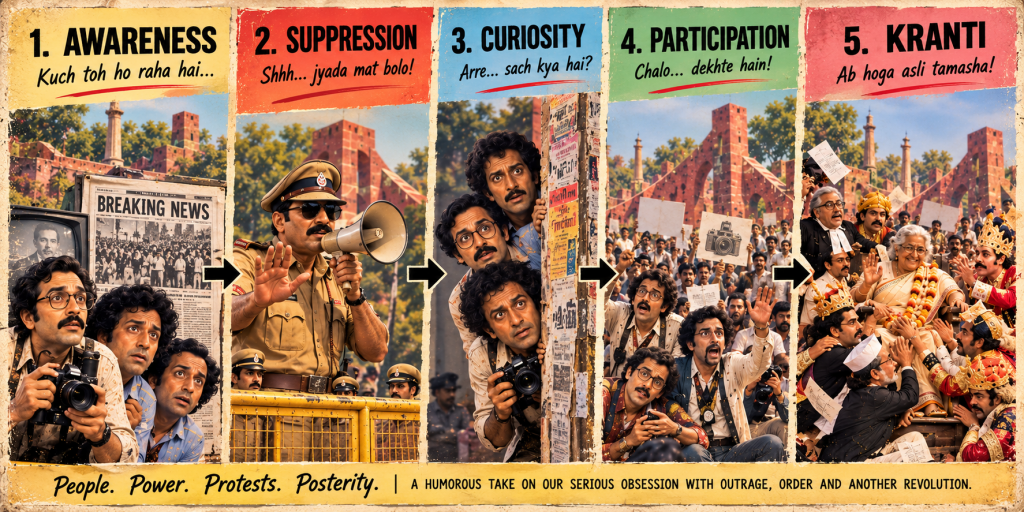
No Meta Ads required.
Manoj Kumar understood organic reach before Zuckerberg was born.
Then came 1983
Two years later, Bollywood apparently looked at Kranti and said:
Bahut ho gaya. Ab reality dikhao.
And gave us Jaane Bhi Do Yaaro.
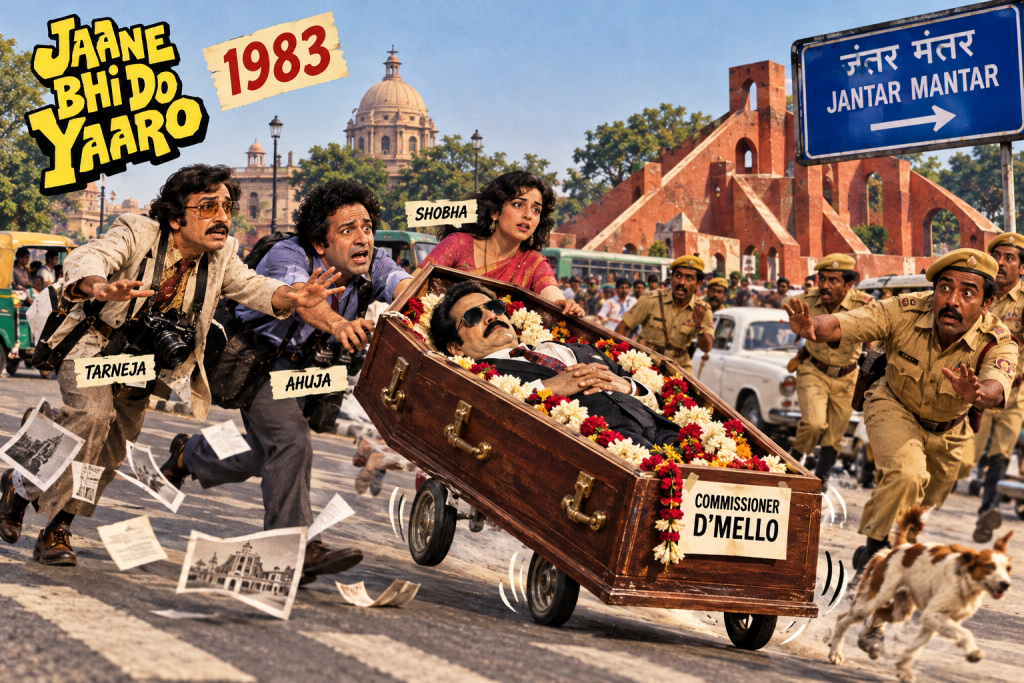
Now there was no majestic revolutionary music.
There were Vinod and Sudhir.
Two photographers trying to earn a living.
There was Tarneja.
There was Ahuja.
There was Shobha.
There was Commissioner D’Mello.
There were builders, officials, journalists, deals, corruption and enough overlapping interests to make a modern WhatsApp group look transparent.
And then there was D’Mello’s dead body.
Possibly the hardest-working corpse in Indian cinema.
Poor D’Mello spends half the movie being transported around Bombay while everyone else is trying to protect themselves.
Nobody really wants D’Mello.
They just don’t want D’Mello to appear in the wrong place.
Which, come to think of it, is an excellent metaphor for uncomfortable questions.
The Oppressor Has One Problem
The Oppressor always believes that dissent is a location.
Find the location.
Barricade the location.
Stop people reaching the location.
Problem solved.
This works beautifully if dissent is a wedding reception.
Unfortunately, dissent behaves more like Wi-Fi.
Block one router and somebody switches on hotspot.
And this is where Kranti accidentally walks into Jaane Bhi Do Yaaro.
In Kranti, suppression creates revolutionaries.
In Jaane Bhi Do Yaaro, suppression creates farce.
And modern India has discovered the magical middle path:
Suppression creates content.
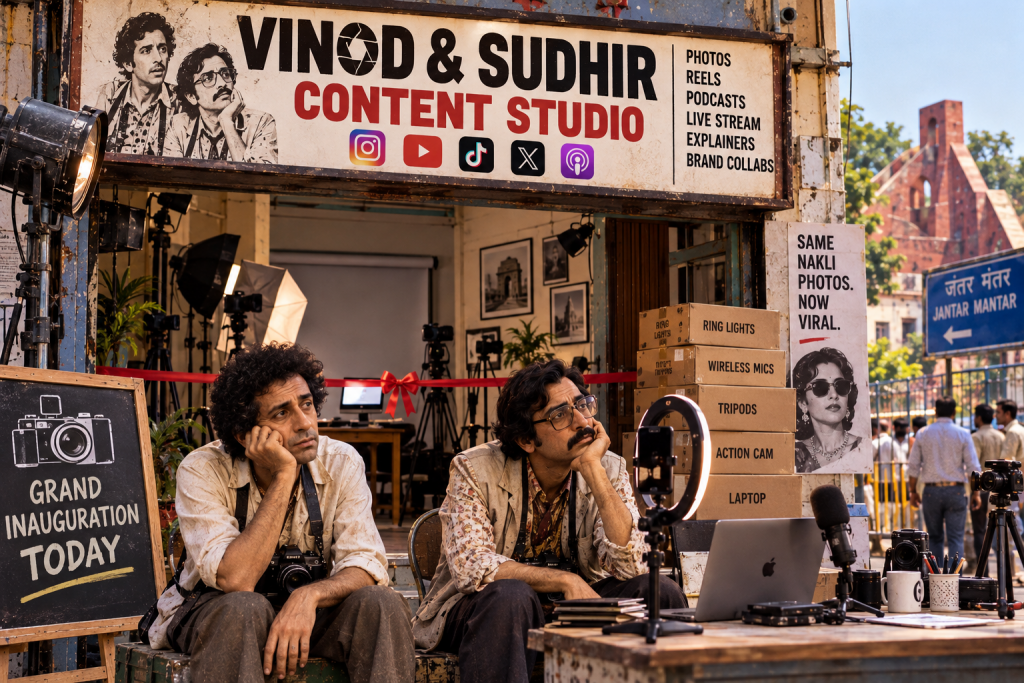
Imagine the meeting.
“Sir, protesters are planning to gather.”
“Stop them.”
“Done, sir.”
“Excellent.”
“Sir, small problem.”
“What?”
“They are now gathering somewhere else.”
“Stop them there.”
“Done, sir.”
“Excellent.”
“Sir…”
“Ab kya?”
“They are gathering in several places.”
At this point Tarneja enters.
Ahuja enters from the other door.
Shobha starts taking notes.
Vinod starts taking photographs.
Sudhir wonders why he ever bought a camera.
And somewhere in the background—
D’Mello’s body disappears again.
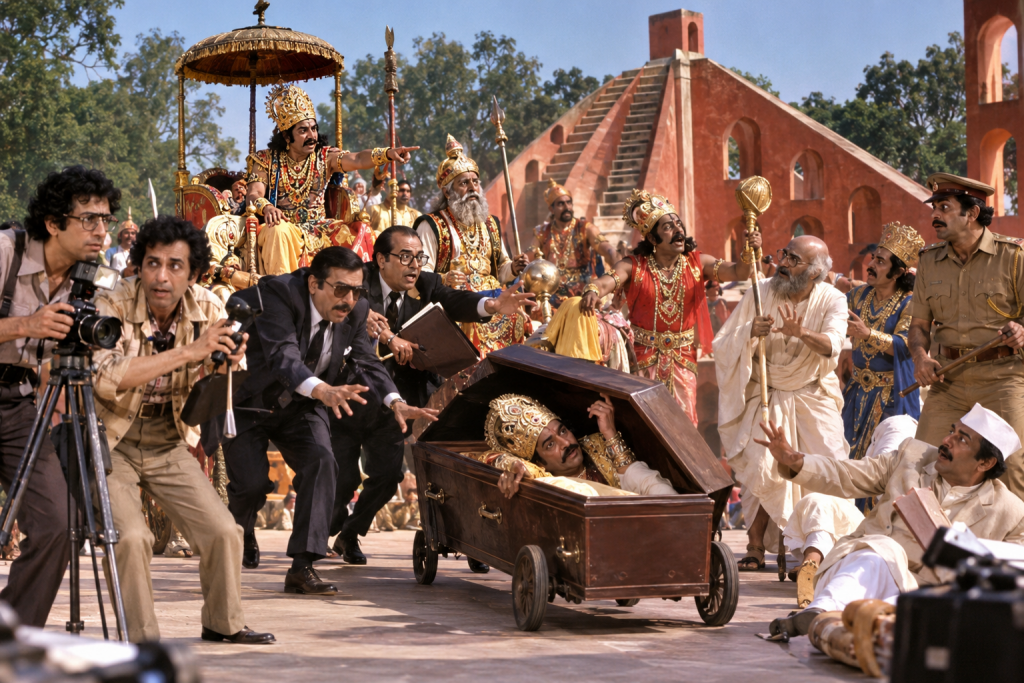
Enter Mahabharata
And obviously, because this is Jaane Bhi Do Yaaro, every Indian institutional crisis must eventually become the Mahabharata.
Draupadi enters.
Then Salim enters.
Then Anarkali enters.
Dhritarashtra is confused.
The audience is confused.
The actors are confused.
D’Mello is dressed as someone from 3000 BC despite being dead for most of the afternoon.
And yet everyone continues performing because nobody knows how to stop the play anymore.
This may be the greatest contribution of Jaane Bhi Do Yaaro to political science.
Institutions rarely collapse dramatically.
They keep functioning.
Bas script change hoti rehti hai.
Everyone continues saying their lines.
Someone moves the body.
Someone changes the narrative.
Someone blames someone else.
Someone announces that everything is completely under control.
Meanwhile D’Mello has crossed three mythological periods and is now lying backstage.
The Protesters Have Changed Too
The Kranti protester needed courage.
The modern protester needs courage and battery backup.
Earlier:
“Inquilab Zindabad!”
Now:
“Bhai vertical video lena.”
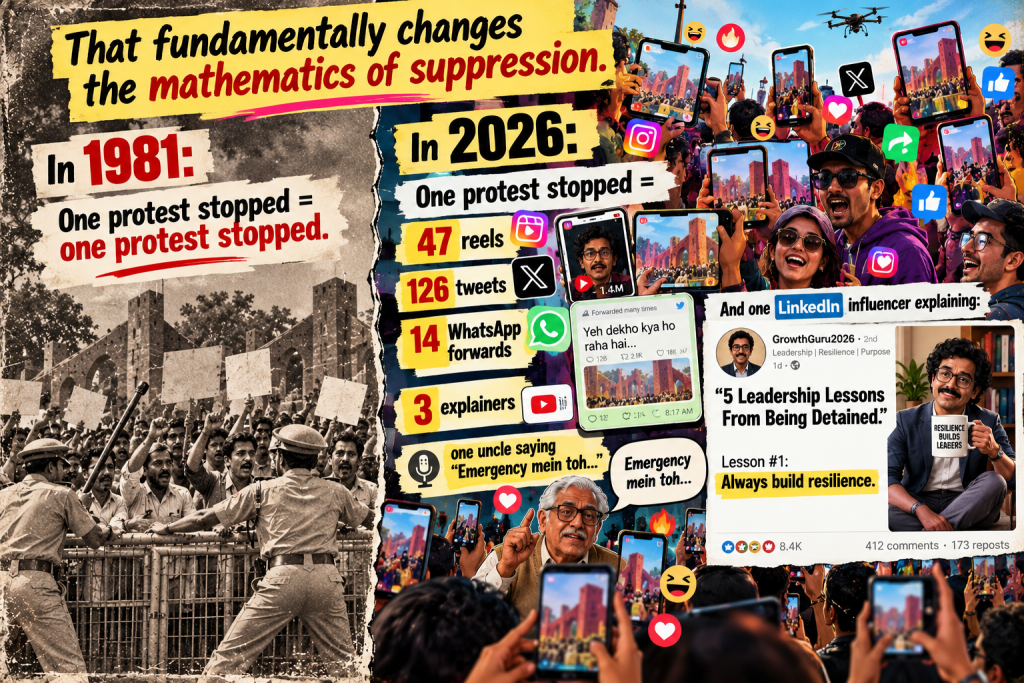
Earlier the state controlled the newspaper, the radio station, the public square.
Today everybody is a newspaper.
Everybody is a cameraman.
Everybody is Vinod.
Everybody is Sudhir.
And unfortunately, everybody is also Shobha—editing the story to suit whichever version gets the maximum engagement.
That fundamentally changes the mathematics of suppression.
The Oppressor Is Still Watching Kranti
This is perhaps the funniest part.
The Oppressor thinks he is fighting Kranti.
Centralised leadership.
Centralised protest.
Centralised messaging.
Centralised revolution.
Find the leader.
Find the stage.
Find the microphone.
Find the crowd.
Control all four.
THE END.
Except the Protester has moved on.
He is living in Jaane Bhi Do Yaaro.
Nobody quite knows who is controlling whom.
Someone is livestreaming.
Someone is making memes.
Someone has already clipped the policeman’s sentence out of context.
Someone else has added Kalesh music.
Tarneja is denying everything.
Ahuja is drunk.
Vinod and Sudhir are wondering how they became activists.
And—
D’Mello is trending.
And Then Gen Z Arrives
This is where both films completely lose control of the screenplay.
Gen Z doesn’t enter carrying a मशाल.
Gen Z enters carrying a power bank.
They look at Manoj Kumar’s two-and-a-half-hour revolution.
They look at Vinod and Sudhir’s two-hour investigation.
And say:
“TL;DR?”
Kranti explains:
“There is systemic oppression and therefore the people must rise collectively against—”
SKIP.
Tarneja begins:
“You don’t understand the complexities of infrastructure development—”
SKIP.
Government begins:
“In view of maintaining law and order—”
SKIP.
D’Mello says nothing.
12 million views.
Someone puts sunglasses on D’Mello.
Someone adds:
POV: When they tried to bury the issue but the issue came to the Mahabharata rehearsal. 💀
Another remix appears:
D’Mello Sigma Edit 🔥
Then:
#JusticeForDMello
Followed immediately by:
#WhoIsDMello
Then:
D’Mello Explained in 30 Seconds.
Then somebody discovers an old photograph and announces that D’Mello was problematic anyway.
#CancelDMello
Within six hours nobody remembers what the original protest was about.
But D’Mello has 2.7 million followers.
Tarneja launches a podcast.
Ahuja starts a YouTube channel.
Shobha becomes a creator.
Vinod and Sudhir start a Substack called Thoda Ruko Yaaro.
And Manoj Kumar is still standing in the corner wondering:
“Kranti kab shuru hogi?”
Beta…
Kranti ho chuki hai.
Bas ab uska aspect ratio 9:16 hai.
Kranti Bhi Do Yaaro.
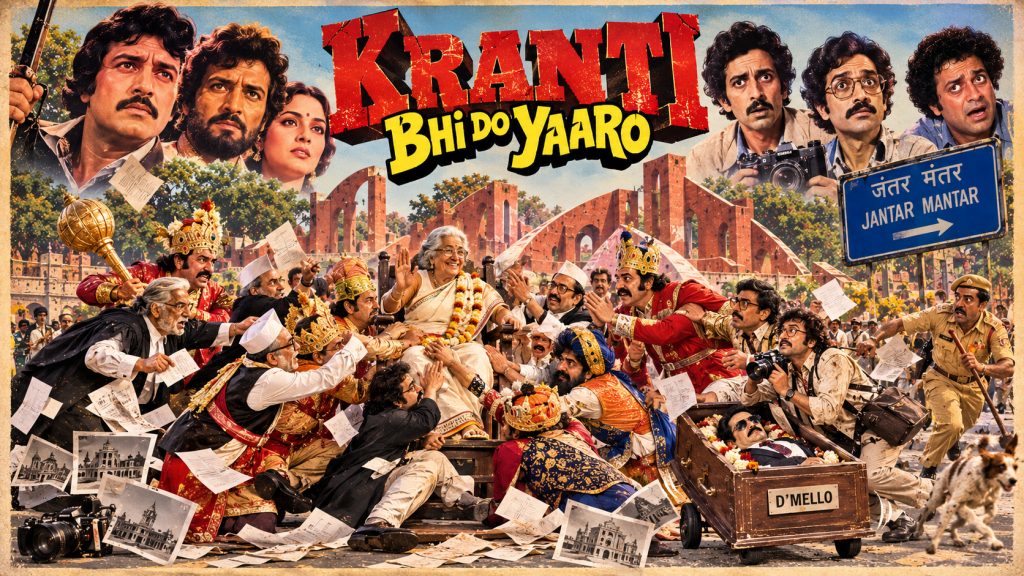
Oppressor: Protest bandh karo.
Protester: Okay Boomer.
Gen Z: Bro just gave the protest free reach. 💀
D’Mello: 💀
Algorithm: People you may know: Kranti.
And somewhere, Kundan Shah is probably looking down at all of us and saying:
“Maine documentary banayi thi. Tum log comedy samajh baithe.”

Outstanding Bhaskar.. The humour and satire is very nice.
Keep writing and sharing!
Amazing writing Bhaskar 👏👏👏
Thoughts to paper and the visualisation is like a movie ! Keep it up 👏👏👏
Cheers / Kunal