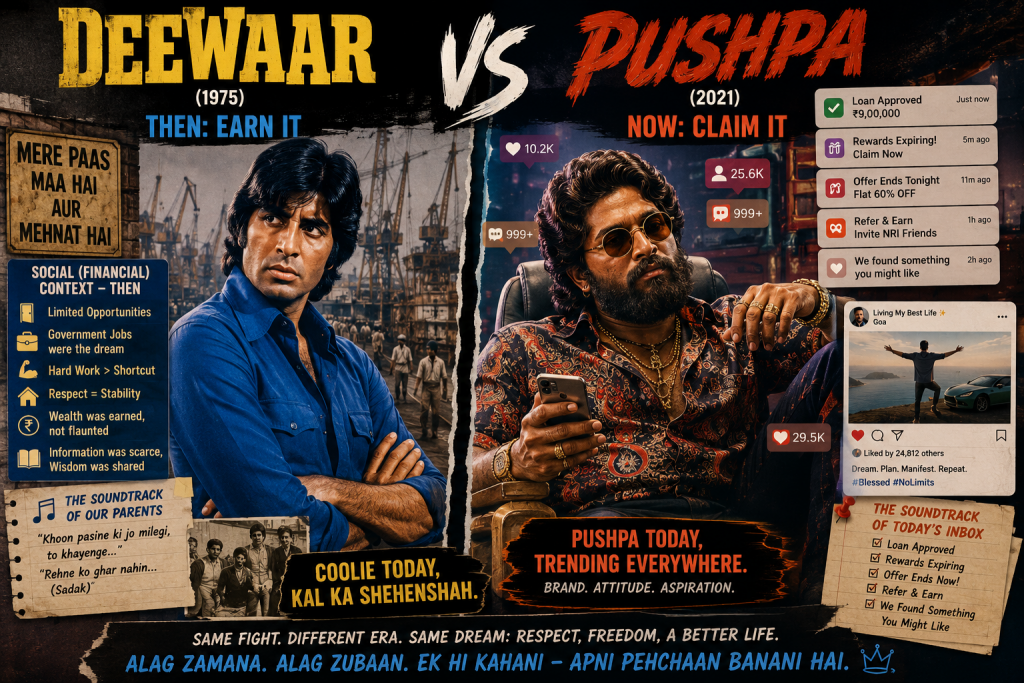
When we were growing up, our entertainment algorithm had exactly three inputs:
- Doordarshan.
- Amitabh Bachchan.
- Whatever poster the neighbourhood video library had outside.
Our walls carried posters of Khoon Pasina, Khuddar, Coolie, Deewar, Shakti, Namak Halaal, Trishul, Mr. India, Ardh Satya and a hundred other films where the hero began with nothing except a mother, a moral compass and occasionally a torn banyan.
Our inbox wasn’t Gmail.
It was the compound walls.
The soundtrack of scarcity
Our Boomer parents sang songs that were practically financial planning workshops.
“Khoon pasine ki jo milegi, to khayenge…”
The lesson was simple.
Work first. Eat later.
Then came:
“Ghar aaya mera pardesi…”
Home mattered.
Then…
“Ghar kab aaoge…”
Family mattered.
And when Sadak reminded us:
“Rehne ko ghar nahin…”
…we didn’t think of real estate appreciation.
We thought of survival.
Even Roti Kapda Aur Makaan wasn’t just a movie title.
It was an annual family budget.
Bollywood’s heroes weren’t rich.
They became rich.
Vijay from Deewar started with a dockyard.
Govinda danced after delivering milk.
Jackie Shroff sold peanuts.
Mithun fought poverty before villains.
Even Rajesh Khanna’s smile usually came after hardship.
The underlying message never changed.
Wealth is created.
Not discovered.
Then I looked at my inbox today.

It reads like this.
Loan approved.
Rewards expiring.
Offer ends tonight.
We found something you may like.
You’ve been pre-approved.
Refer your NRI friend.
Flat 60% off.
Apparently…
…I am just one click away from becoming Warren Buffett with an Airtel loan, an IndusInd credit card and Tata CliQ Cash.
My Gmail seems convinced my only problem in life is that I haven’t accepted enough offers.
We were sold dreams.
They are sold possibilities.
That’s a very different burden.
Our generation heard:
“Work hard and maybe you’ll make it.”
Gen Z hears:
“Success is already available.
Why haven’t you claimed it yet?”
Scarcity creates anxiety.
Abundance creates decision fatigue.
Neither is easy.
Don vs Pushpa
When Don said,
“Don ko pakadna mushkil hi nahin…”
we admired confidence.
When Pushpa says,
“Pushpa jhukega nahin…”
it isn’t just swagger.
It’s branding.
Identity.
Social media positioning.
Every generation gets the hero it needs.
Don walked into one cinema hall.
Pushpa enters millions of Instagram reels.
The pressure has multiplied.
We compared marks.
They compare metrics.
We had report cards.
They have followers.
We waited for Friday’s movie release.
They refresh notifications every five minutes.
We worried about getting a job.
They worry whether AI will take the job before they graduate.
Our competition was Sharma ji ka beta.
Their competition is…
the entire internet.
We consumed one story every Friday.
They consume five hundred stories every day.
Every scroll says:
Someone bought a house.
Someone is travelling to Iceland.
Someone exited a startup.
Someone is twenty-three and financially free.
Someone runs an ultramarathon before breakfast.
Someone is happier.
Someone is richer.
Someone is prettier.
Someone is more productive.
Even their failures come with cinematic lighting.
Maybe Gen Z isn’t entitled.
Maybe they’re overloaded.
We grew up believing opportunity was rare.
They grow up believing opportunity is infinite.
That’s beautiful.
It’s also exhausting.
When everything looks possible…
choosing one path becomes the hardest job.
Perhaps every generation envies the wrong thing.
Boomers envy our freedom.
We envy Gen Z’s technology.
Gen Z probably envies the peace of not being online.
Meanwhile every generation secretly wishes it had the soundtrack of another.
The final scene
If Bollywood were remaking our lives…
Our opening credits would begin with Khoon Pasina.
The interval would be Khuddar.
The climax would probably be Gmail announcing:
Congratulations! Your pre-approved loan is waiting.
And somewhere in the background…
Amitabh Bachchan would quietly ask,
“Beta, loan approve ho gaya… lekin sapna kisne approve kiya?”

Gen Z doesn’t need another lecture about hard work.
They already work—just in a world where the noise is louder, the choices are endless, and every screen is trying to sell them a shortcut.
Our generation learned that wealth comes after effort.
Their generation has to learn which promises to ignore before effort begins.
That may be an even harder lesson.
So before we dismiss them as “kids these days,” perhaps we should applaud them.
They’re trying to build character in a world that’s constantly trying to sell convenience.
And if they manage that…
they might just become the strongest generation yet.
