The older I get, the more I realise that running is not about proving what I could do yesterday. It’s about discovering what I can do today.
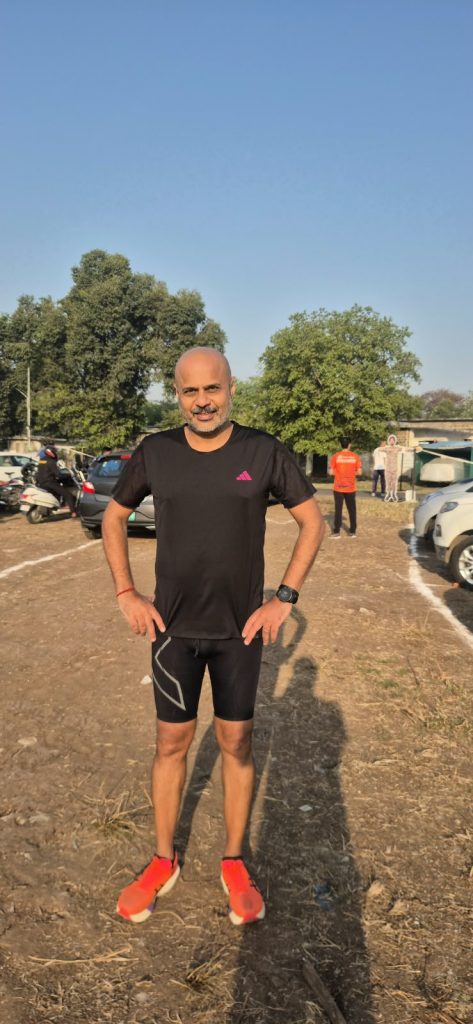
This week, I ran the CME Soldierathon Half Marathon in 1:48:55.
But this wasn’t a race for me.
It was a dipstick test.
A way to measure where I stand after weeks of knee trouble, rehabilitation, interrupted training and repeated attempts to get back to running normally.
The biggest learning?
There is no foolproof formula for returning from injury.
You train. You test your limits. You listen. And when necessary, you dial things down.
Google can give you a thousand rehabilitation protocols. Your knee, unfortunately, doesn’t read Google.
The Week: When the Lungs Joined the Protest
The knee had already made its objections known during this training block.
This week, Pune’s post-Diwali air quality decided to participate.
Tuesday was reduced to a low-intensity Zone 1 outing because of respiratory discomfort. Thursday was a 5.3 km walk.
Saturday brought a little reassurance: 0.8 km of warm-up followed by 10.3 km of aerobic running in approximately an hour, at 5:52/km for the main section.
Then came Sunday.
My longest run since February.
CME Soldierathon: 21 KM of Military Engineering and Some Very Civilian Knees
The College of Military Engineering in Pune is a remarkable place to run.
Beautiful roads, greenery, the rowing arena, military buildings, combat engineering facilities and tanks!
Not many half marathons give you an opportunity to admire military hardware while wondering whether your own chassis will survive another five kilometres.
The route management was excellent, the support was wonderful, and the terrain was interesting.
Particularly towards the end.
The course offered some welcome downhill stretches through the middle, followed by undulations that felt considerably more demanding once the legs had covered 16 kilometres.
I’ll write a detailed review of the CME Soldierathon separately. The route and the institution deserve their own story.
The Plan: Four Kilometres at a Time
I didn’t want to run this half marathon like a conventional race.
The plan was simple: run 4 km, take a 15-second recovery, repeat.
The idea wasn’t to gain time. It was to break the distance into manageable pieces, check how the knee felt and avoid getting carried away by the excitement of a crowded race.
My running blocks looked like this:
| Distance | Pace |
|---|---|
| First 4 km | 5:00/km |
| Next 4 km | 5:01/km |
| Next 4 km | 5:08/km |
| Next 4 km | 5:11/km |
| Next 4 km | 5:16/km |
| Final | 5:24/km |
I had been running around 5:00–5:10/km during training, sometimes quite comfortably.
But here’s something age and injury have taught me:
History has no significance in running.
Your old personal best doesn’t turn up to help you on a climb. Last month’s easy pace doesn’t guarantee today’s easy effort.
Every run starts with the body you have that morning, not the one you remember having.
What Happened After 16 KM?
The splits show that I slowed down after 16 km.
But the numbers don’t tell the whole story.
I became increasingly aware of every muscle around my right knee.
The quadriceps. The surrounding muscles. Every little sensation that I might previously have ignored.
I wasn’t necessarily in pain. I was paying attention.
Perhaps too much attention!
And without consciously planning it, I began changing how I ran.
My cadence increased from 172 steps per minute in the first 4 km to around 174–175 later in the race.
My average stride length shortened from 1.17 metres to 1.06 metres by the final kilometre.
Shorter strides. Quicker steps. A deliberate attempt to manage the impact on the knee.
The interesting part is that the adjustment started well before the final kilometres.
My heart rate remained fairly stable through 16 km, then increased as the terrain became more demanding and fatigue accumulated.
Was I protecting the knee? Was I tired? Was I responding to the hills?
Probably a little of everything.
And that’s what makes running such an interesting experiment.
Garmin gives you the numbers. Your body provides the commentary. Sometimes the two agree.
Injury Management Is a Learning Process
One thing this training block has taught me is that returning from injury requires considerably more reading, observation and experimentation than I had imagined.
There is no magic workout.
No universal recovery timeline.
No guarantee that because you could run a particular pace last month, you should run it today.
There are days when you feel fantastic and need to resist the temptation to do more.
And days when the body asks you to slow down, even when the training plan says otherwise.
With age, adaptation becomes more important than ambition.
Not because ambition disappears.
But because you want to keep running long enough to enjoy it.
Closing This Training Block
This post marks the end of my current training block.
It started with plans, pace targets, threshold sessions and long runs.
Then the knee intervened.
There were visits to the physiotherapist, periods of rest, cautious returns, setbacks and a lot of Zone 1 and Zone 2 running.
The CME half marathon was a useful way to close the chapter.
Not because I ran particularly fast.
But because I covered my longest distance since February, learned something about how my running mechanics change under fatigue, and finished with a clearer understanding of what needs work.
The next training block begins with the Feb FM in sight.
I’ll start a fresh training log for that phase.
The objectives remain. The approach will evolve.
As for this block, I’ll leave it with one thought:
The purpose of training isn’t to prove that you can still run like your younger self. It’s to discover how to keep running as your current self.
The engine is willing. The chassis needs maintenance.
And the driver is still learning.
Picture abhi baaki hai, mere dost! 🏃♂️
P.S. A detailed CME Soldierathon race review will follow. The route, the rowing arena, the military engineering facilities, the tanks and those sneaky hills deserve a post of their own.

Loved the closing – those sneaky hills deserve a post of their own. :))