Have you Seen the Die Hard Series?
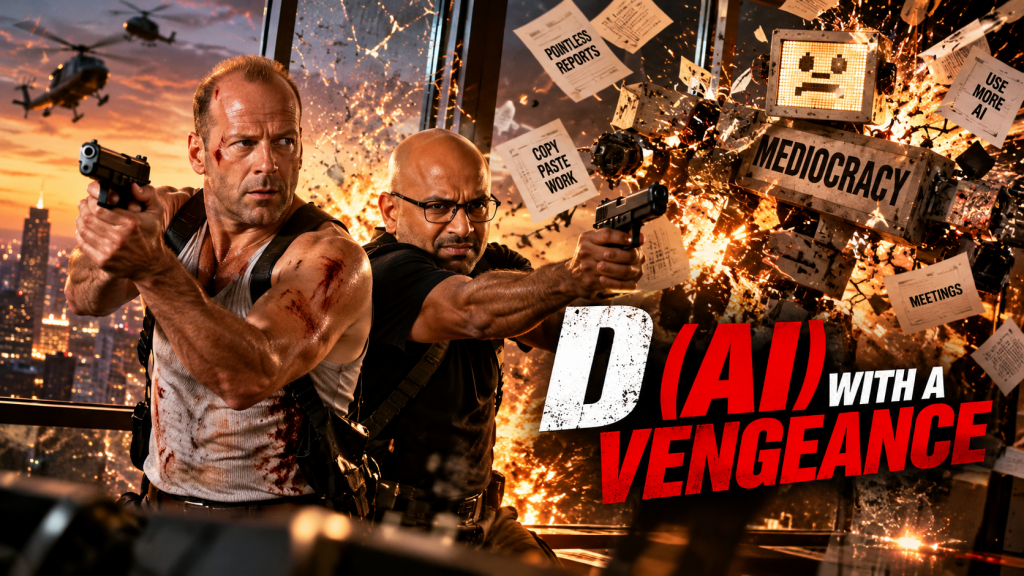
If John McClane were looking for a job in 2026, he would probably be rejected.
HR: Are you AI-native?
McClane: No.
HR: ChatGPT?
McClane: No.
HR: Claude?
McClane: Who’s Claude?
HR: Gemini? Agents? MCPs? Vibe coding?
McClane: I have a walkie-talkie.
HR: Unfortunately, John, we’re looking for someone more future-ready.
And that, I suspect, is roughly where we are with AI today.
We have started confusing using the tool with possessing the skill.
LinkedIn is full of people proudly announcing that they use 11 AI tools before breakfast.
There are courses on prompting.
Courses on agents.
Courses on using agents to create agents.
Courses teaching you how to ask Claude to ask ChatGPT to research something on Perplexity so that Gemini can convert it into a PowerPoint that nobody will read.
And all of this is called:
Upskilling.
I am not so sure.
Because the next phase of AI may turn this entire equation upside down.
Soon HR may not ask:
“How much AI do you know?”
They may ask:
“How much AI do you need?”
Welcome to AI Mileage
A fascinating little story appeared this week.
Accenture reportedly introduced limits around AI consumption after some employees were running up Claude usage worth as much as $1,000 per month.
Now think about that from the CFO’s perspective.
You hire someone for ₹30 lakh CTC.
Laptop.
Insurance.
Internet.
Bonuses.
And then discover that the fellow has developed a ₹6–10 lakh annual relationship with Claude.
Suddenly he isn’t a ₹30 lakh employee.
He is a ₹38 lakh employee with an AI dependency.
Which means the interview of 2028 may be very different.
Candidate A:
“I use Claude, ChatGPT, Gemini, Perplexity, Cursor and seven agents.”
HR: “Monthly AI spend?”
“₹48,000.”
HR: “Thank you. We’ll get back to you.”
Candidate B walks in.
HR: “What AI tools do you use?”
“Whatever is required.”
HR: “Monthly spend?”
“₹1,800.”
HR: “And your output?”
“Same as Candidate A.”
HR looks at Finance.
Finance looks at HR.
“When can you join?”
We may soon have a new professional metric.
Not AI proficiency.
Not prompt engineering.
Not number of agents.
AI mileage.
Output per token.
Nobody Bragged About Using More Swords
This brings us to Genghis Khan.
When humans fought wars with swords, the greatest warrior wasn’t necessarily the chap with the largest collection of swords.
Nobody arrived at a battlefield saying:
“Bro, I am Sword Native.”
And nobody updated his LinkedIn headline:
⚔️ Sword Evangelist | 17+ Blades | Cutting-Edge Warrior | Helping Armies Unlock Sword Transformation
The sword was a tool.
Power came from knowing the battlefield.
Where to attack.
When to retreat.
How to move.
How to organize.
How to read the enemy.
And, importantly:
when not to draw the bloody sword.
The Mongols weren’t terrifying because Genghis Khan had discovered SwordGPT.
Their advantage came from mobility, organization, communication, intelligence, discipline and tactics.
Imagine the annual appraisal.
Genghis Khan: How many kingdoms did you capture?
General A: Seven.
Khan: Horses?
General A: 2,000.
Khan: Good.
General B: Seven kingdoms.
Khan: Horses?
General B: 19,000 horses, 11,000 swords, 40,000 arrows and $973 of Claude credits.
Khan: अच्छा है.
LinkedIn पे thought leadership करो. युद्ध तुमसे ना हो पाएगा।
Then There Was John McClane
Which brings us back to Die Hard.
Hans Gruber has everything.
Weapons.
Explosives.
Technology.
A sophisticated team.
A detailed plan.
Excellent tailoring.
John McClane has:
one gun,
a walkie-talkie,
no shoes,
a white vest,
and a fairly serious attitude problem.
Hans has more tools.
McClane has better situational intelligence.
That is the entire AI debate in one movie.
AI gives you leverage.
But leverage does not automatically create intelligence.
It amplifies whatever was already there.
Give a smart person AI and you may get extraordinary productivity.
Give an idiot AI and you get…
an extremely productive idiot.
And unfortunately, the idiot can now operate at machine speed.
Artificial Intelligence Meets Natural Stupidity
I recently received this message:
“Dear Guest, we miss you at Vijay Sales! Redeem Rs. 250 worth bonus points in your loyalty A/C. Enjoy Exciting Deals & More Savings.”
I had bought a dishwasher.
Apparently the combined power of CRM + Automation + Data + AI has concluded:
This man likes dishwashers.
Perhaps I should buy another one.
2026 — Dishwasher.
2027 — Dishwasher.
2028 — Dishwasher.
By 2032 every plate in my house can have its own dedicated dishwasher.
Customer Lifetime Value achieved.
The problem here isn’t lack of technology.
There is plenty of technology.
The problem is that somewhere in this magnificent automated marketing stack, nobody asked:
“How often does a normal human being buy a dishwasher?”
That question requires something far more sophisticated.
Common sense.
Unfortunately, I haven’t yet found the SaaS subscription for it.
ECI Also Discovered the Difference Between AI and I
India has produced an even larger case study.
The Election Commission has been using technology and AI-assisted systems to identify things such as potentially similar voter photographs and demographic records.
Conceptually, perfectly sensible.
Let machines find patterns across millions of records.
That is exactly what machines are good at.
But during the SIR exercise, large numbers of voters reportedly ended up being flagged for “logical discrepancies”, including issues involving names, spellings, transliteration and matching older records.
Which is where AI meets India.
Because somewhere a computer encounters:
Bhaskar Thakur
Then:
Bhaskar Kumar Thakur
Then:
भास्कर ठाकुर
Then an old handwritten electoral record that appears to say:
Bhaskar Thakoor
Machine:
🚨 POSSIBLE LOGICAL DISCREPANCY 🚨
Human:
“Arre bhai, same aadmi hai.”
Eventually procedures themselves had to accommodate more human intervention.
And therein lies the lesson.
AI can identify.
AI can flag.
AI can rank.
AI can predict.
AI can recommend.
But before the machine’s conclusion affects an actual human being, somebody still needs to ask:
“Does this make sense?”
That person may become the most valuable employee in the company.
The Job Interview of 2029
Imagine two candidates being given the same marketing problem.
Candidate One
Opens Claude.
Creates five agents.
One researches competitors.
One creates personas.
One analyzes reviews.
One creates strategy.
One summarizes the other four agents.
Then ChatGPT converts everything into a 78-page presentation.
Time: 4 hours.
AI spend: ₹6,850.
Slides: 78.
Insights: 3.
Candidate Two
Reads the brief.
Looks at the numbers.
Calls one customer.
Asks three questions.
Uses Google.
Opens Excel.
Uses AI for twenty minutes to test two hypotheses.
Time: 2 hours.
AI spend: ₹83.
Slides: 7.
Insights: 5.
Who is more AI-native?
I would hire Candidate Two.
Because Candidate Two understands something Candidate One doesn’t.
AI is not the work.
AI helps you do the work.
Soon Your Claude Bill May Become Part of Your CTC
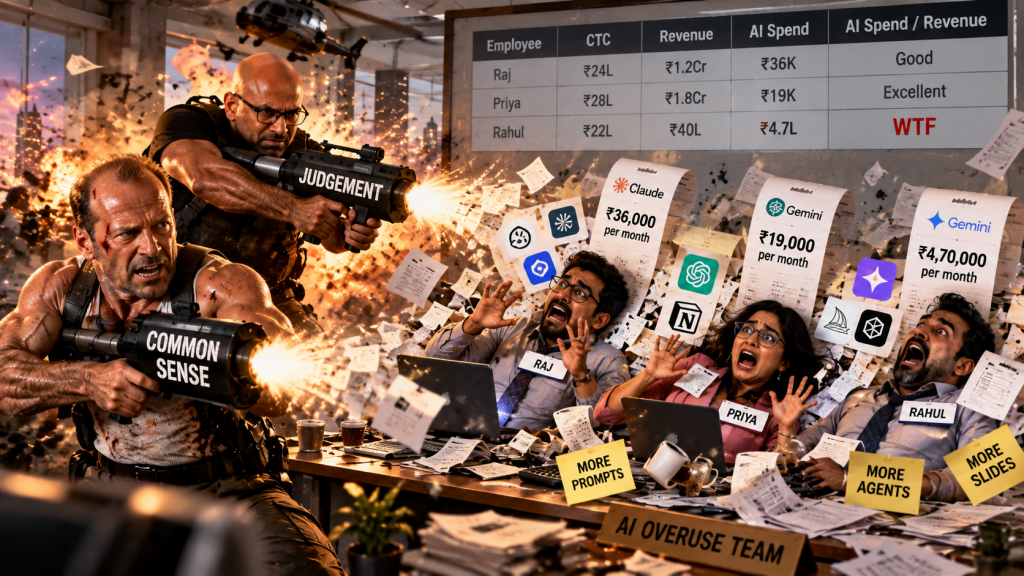
This is where things get interesting.
For the moment companies are excited about AI adoption.
Management meetings probably contain sentences like:
“We need to accelerate enterprise AI transformation.”
Fantastic.
Wait until Finance arrives.
Finance has an extraordinary ability to turn revolutions into spreadsheet columns.
Soon somebody will create this:
| Employee | CTC | Revenue | AI Spend | AI Spend / Revenue |
|---|---|---|---|---|
| Raj | ₹24L | ₹1.2Cr | ₹36K | Good |
| Priya | ₹28L | ₹1.8Cr | ₹19K | Excellent |
| Rahul | ₹22L | ₹40L | ₹4.7L | WTF |
Then Rahul’s manager will discover that Rahul has been asking Claude to write:
“Thanks, received.”
At which point HR policy will evolve very quickly.
Maybe January 2028:
Use whatever AI you want.
We’ll deduct it from your salary.
Suddenly prompt engineering will become very precise.
We Are Currently Tokenmaxxing
AI today reminds me of bodybuilding culture.
“How many agents are you running, bro?”
“Fourteen.”
“Brooooo!”
“How many tokens?”
“Two million before lunch.”
“BEAST!”
Everyone is tokenmaxxing.
Then the CFO enters the gym.
“How much did all this cost?”
Silence.
Within six months:
Token shaming.
“Bro… you used 70,000 tokens to write that email?”
“Please don’t tell anyone.”
Prompt Engineering Will Become Calculator Engineering
There was a time when knowing how to operate a calculator was a useful skill.
Then everybody got calculators.
Today nobody writes:
Advanced Calculator User
on their CV.
Because the calculator was never the skill.
Mathematics was.
Excel isn’t finance.
Photoshop isn’t design.
Google isn’t knowledge.
PowerPoint isn’t strategy.
A sword isn’t warfare.
And:
AI isn’t intelligence.
AI is leverage.
And once everyone has access to roughly the same leverage, advantage moves somewhere else.
To judgement.
The Next Skill Gap Will Be Restraint
The first AI skill was:
Can you use it?
The second will be:
Can you use it well?
The third—and most interesting—will be:
Do you know when NOT to use it?
That requires things prompting courses cannot easily teach.
Context.
Experience.
Taste.
Curiosity.
Domain knowledge.
Empathy.
Commercial judgement.
Common sense.
The ability to recognize bullshit.
And the confidence to occasionally look at an AI-generated answer and say:
“No.”
AI Native May Soon Become an Insult
Today “AI Native” sounds impressive.
Two years from now it may sound like:
“Requires AI assistance for basic cognitive functioning.”
That would be unfortunate.
Because the best employees won’t compete with AI.
They won’t worship AI either.
They will treat it exactly like every great technology before it.
As a tool.
A very powerful tool.
But still a tool.
The sword doesn’t make the warrior.
The calculator doesn’t make the mathematician.
The camera doesn’t make the photographer.
And Claude doesn’t make the strategist.
D (AI) with a Vengeance
So, dear job seekers:
Please learn AI.
Use ChatGPT.
Use Claude.
Use Gemini.
Build agents.
Automate repetitive work.
Learn what these systems can do.
You would be foolish not to.
But don’t confuse the ability to wield the sword with the ability to fight the battle.
Because everyone will soon have the sword.
And when everyone has one, the advantage shifts to the person who understands when to draw it, where to use it and when to put it back.
John McClane didn’t beat Hans Gruber because he had better technology.
He had considerably less.
He won because he understood the situation better.
That may also be the future of work.
While twenty “AI-native” candidates are sitting outside Nakatomi Plaza asking Claude:
“Create a comprehensive multi-agent framework for resolving a hostage situation…”
some irritating fifty-something fellow will already be upstairs.
Barefoot.
Using his brain.
Getting shit done.
With remarkably low token consumption.
AI is your sword.
It is not you.
And perhaps the most impressive line on the CV of 2028 won’t be:
AI Native.
It will be:
Gets shit done. AI bill available on request.
Yippee-Ki-Yay, Claude.
