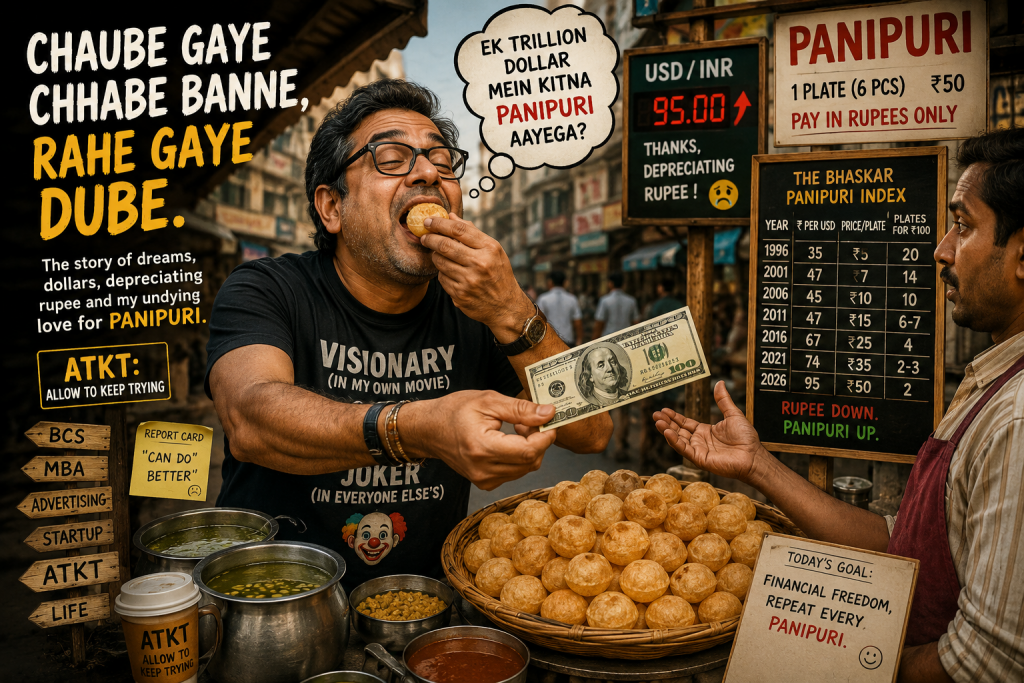
There is an old saying: “Chaube gaye chhabe banne, rahe gaye dube.”
Roughly translated: a man went out to become something bigger, and came back smaller than where he started.
In my case, this was not just a saying.
It became a life operating system.
My educational journey started with a very simple business model:
Parents invested. I under-delivered.
Like most middle-class Indian parents, mine looked at education as the safest investment. No mutual fund, no fixed deposit, no plot of land could match the ROI of a child who studied well.
Unfortunately, I was not that asset class.
My report cards had one consistent line item:
“Can do better.”
It was less a teacher’s comment and more an annual audit report.
Not excellent.
Not poor.
Just that permanently floating middle-class verdict:
Can do better.
And I did continue to do better.
Just never enough for it to show on paper.
Somehow, after the marksheet battles, the engineering dream funeral, and the emotional jugaad of admissions, I landed in BCS.
As I wrote in my earlier ATKT story, I entered that world not as a Vidyarthi, but almost as Vidya ki Arthi.
I had already discovered ATKT — Allow To Keep Trying — before life officially taught me the concept.
Then, somehow, came MBA.
“Somehow” is an important word in my biography.
Not because I don’t remember how things happened.
Because explaining them logically would require a lot of fiction.
So there I was: average marks, average confidence, above-average imagination.
And then life gave me a good opportunity.
I got a chance to work in the advertising industry.
For a boy who had grown up on cinema, posters, jingles, brand lines, and filmy dreams, advertising should have been perfect.
It had ideas.
It had chaos.
It had people pretending to understand consumers while drinking cutting chai.
But at that exact moment, a dangerous thing happened.
I thought I was a visionary.
This is a very risky disease. Especially when caught early.
I looked at the ad industry opportunity and thought:
“This is good, but I am meant for bigger things.”
In my head, violins started playing.
The camera moved in slow motion.
The hero looked into the horizon.
A startup was born.
In everyone else’s head, probably only one thought came:
“Isko naukri mili thi. Yeh kya kar raha hai?”
But the hero had left the building.
Or so he thought.
Over the years, life became like a cinema where I always believed I was the hero.
The struggler.
The dreamer.
The man ahead of his time.
The only small problem was that everyone else seemed to think I was the joker.
In my film, I was Amitabh walking in slow motion.
In their film, I was Asrani stuck at the gate.
And this is the great tragedy of entrepreneurship.
You are always the hero in your own pitch deck.
But in real life, the market gives feedback like a strict Fergusson professor:
“Can do better.”
I thought I was building something big.
Life thought I was collecting ATKTs in new subjects.
Academic ATKT had papers like Maths, Statistics, Accounts.
Entrepreneurial ATKT had new subjects:
Cash flow.
Clients.
Payroll.
Hiring.
Firing.
GST.
TDS.
Follow-ups.
And that legendary paper called:
“Payment will be released next week.”
In college, at least the backlog came with an exam date.
In business, backlog comes with interest.
But somewhere in this long movie, I also built a dream.
Like many middle-class boys who discovered ambition late, I had my own retirement target.
I told myself:
“When I have a million dollars, maybe five million dollars, I will retire.”
A very clean plan.
Earn.
Invest.
Retire.
Write.
Run.
Eat panipuri.
Actually, let me correct that.
Not eat panipuri.
Eat panipuri without looking at the price.
That is real financial freedom.
But there was one small Excel error in this retirement model.
I was dreaming in dollars.
I was earning, spending, paying salaries, paying taxes, paying EMIs, paying for running shoes, and buying panipuri in rupees.
And between 1996 and 2026, the rupee did what my report card always predicted.
Can do better.
In 1996, one dollar was roughly ₹35.
By 2006, it was around ₹45.
By 2016, around ₹67.
And in 2026, it has been hovering in the ₹95 range.
So the dollar did not just become expensive.
It became that NRI cousin who visits India once in three years and suddenly makes everyone feel poor.
But the real damage is not visible in forex charts.
It is visible at the panipuri stall.
So I created my own economic indicator.
The BT Panipuri Index
This is not RBI-approved.
This is not SEBI-registered.
This is not recommended by wealth managers.
But emotionally, it is more accurate than most financial planning calculator
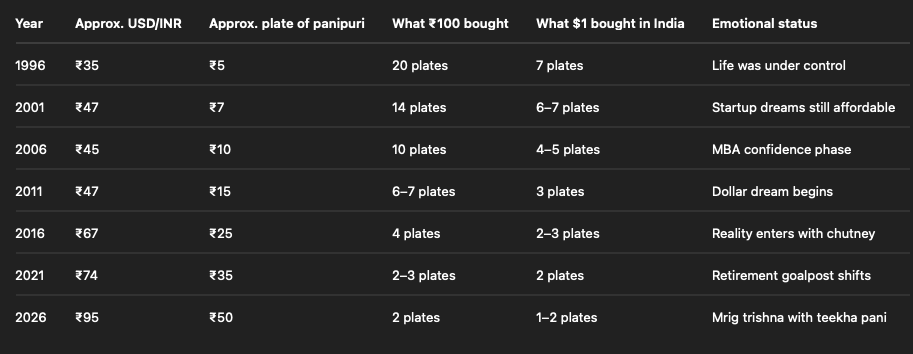
The panipuri prices are approximate, because every city, every stall, and every childhood memory has its own inflation rate.
But the emotion is accurate.
In 1996, ₹100 meant 20 plates of panipuri.
In 2026, ₹100 means two plates.
So when people say, “The rupee has depreciated,” I don’t think of macroeconomics.
I think:
“Mere 18 plates panipuri kisne kha liye?”
This is the real loss of purchasing power.
Not GDP.
Not current account deficit.
Not fiscal deficit.
The real deficit is standing at a panipuri stall, wanting a second plate, and your brain saying:
“Control kar. Retirement planning chal raha hai.”
In 2012, a million dollars felt like a beautiful finish line.
One million dollars was roughly ₹5.5 crore.
By 2026, the same million dollars became roughly ₹9.5 crore.
Same dream.
Same number.
Same ego.
But the rupee had quietly changed the exam paper.
Five million dollars, which once sounded like “retire and write peacefully,” now sounds like:
“Retire, but maybe keep one client on retainer.”
This is not finance.
This is emotional foreign exchange loss.
And then, while I am doing this middle-class math, I read that someone in the world is worth close to a trillion dollars.
At that point my brain stops behaving like a founder and starts behaving like a boy standing at a chaat stall.
“Ek trillion dollar mein kitna panipuri aayega?”
Let us calculate.
At ₹95 to a dollar, one trillion dollars is ₹95 lakh crore.
At ₹50 a plate, that is:
1.9 trillion plates of panipuri.
Not puris.
Plates.
If one plate has six puris, that is:
11.4 trillion puris.
That is not wealth.
That is civilisation-level teekha pani.
Other people calculate net worth.
I calculate pani puri capacity.
One million dollars?
Good.
Five million dollars?
Very good.
One trillion dollars?
Bhai, entire India can eat panipuri, ask for sukha puri, and still leave money for mineral water.
And suddenly, ambition becomes comedy.
Because what are we really chasing?
Marks?
Degrees?
Jobs?
Startups?
Dollars?
Valuation?
Retirement?
Respect?
A LinkedIn headline?
Or are we simply trying to reach a point where we can stand at a panipuri stall and say:
“Bhaiya, aur daalo. Aaj calculation nahi karna.”
That is my real FIRE number.
Not Financial Independence, Retire Early.
Financial Independence, Repeat Every Panipuri.
At 18, I wanted marks.
At 22, I wanted a career.
At 30, I wanted a company.
At 40, I wanted wealth.
At 50, I want clarity.
And occasionally, good hing in my panipuri water.
The truth is, I have spent much of my life going from one exam to another.
First academic.
Then professional.
Then entrepreneurial.
Then financial.
Every time I thought the paper was over, life said:
“Supplementary attempt available.”
That is the real continuation of ATKT.
ATKT was never just about college.
ATKT was training.
It taught me that failure is not final.
It is just badly scheduled feedback.
It taught me that you may not top the class, but you can still stay in the game.
It taught me that “can do better” is not an insult.
It is a lifetime subscription.
And maybe that is why I am still here.
Still trying.
Still laughing.
Still calculating impossible wealth in panipuri.
Still imagining myself as the hero, even if the audience has bought tickets for a comedy show.
So yes, Chaube gaye chhabe banne, rahe gaye dube.
I went out to become bigger.
Many times I came back smaller.
But I came back.
And that matters.
Because whether it is BCS, MBA, advertising, startup, money, or life itself — my real degree remains the same:
ATKT: Allow To Keep Trying.
And my final report card?
Still the same.
Can do better.
But this time, I’ll take it.

Interesting perspective and the pani puri example is quite funny !
Ha ha ha – very interesting and now I am craving that paani Puri ( not looking at the price 😜) while reading this on a Mumbai monsoon day!!
Keep writing – your humour and style is amazing