The Deewaar insult worked because Vijay was being judged through his father.
His father’s past was stamped onto the son.
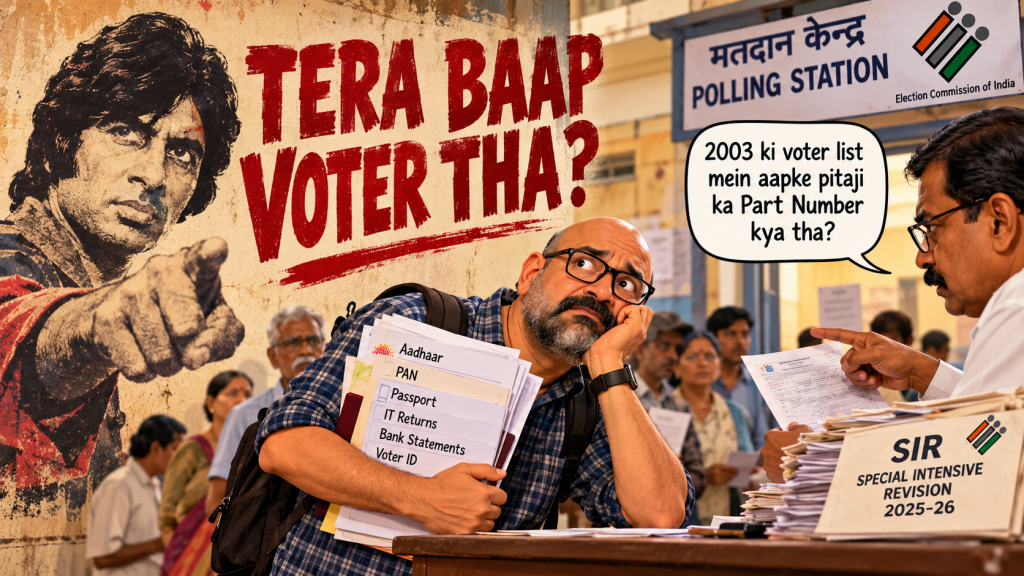
Obviously SIR isn’t Deewaar, and electoral eligibility isn’t inherited from your father.
But the form can create a wonderfully Bollywood-esque feeling:
Why am I suddenly investigating Papa to establish Bhaskar?
I am an Indian citizen today.
I have a current identity today.
I have a current residence today.
I have decades of records today.
So verification should primarily answer:
“Who is this man?”
Not accidentally turn into:
“Iske Papa 23 saal pehle kis Part Number mein the?”
There is a subtle difference.
One is verification.
The other feels like ancestry.com — Election Commission Edition.
This Isn’t a Gen Z Problem
And that’s why I don’t think this is primarily a Gen Z story.
Quite the opposite.
Gen Z was born into databases.
Many of us weren’t.
I left Jamshedpur in the 1990s.
There was no Aadhaar.
No DigiLocker.
No cloud.
No Google Drive.
No scanned folder called:
FINAL_DOCUMENTS_FINAL_V3_USE_THIS_ONE.pdf
Our DigiLocker was a Godrej almari.
Our search engine was Mummy.
“Mummy, birth certificate?”
“Blue file.”
“Blue file kahan hai?”
“Almari mein.”
“Almari mein kahan?”
“Saamne.”
And astonishingly, she was usually right.
But ask:
“Mummy, 2003 ka electoral-roll Part Number?”
Even Google’s servers would start sweating.
The Real Indian Story Is Migration
Consider a completely normal Indian.
Born in Jamshedpur.
Studies in Pune.
Works in Delhi.
Moves to Bengaluru.
Marries someone from Patna.
Moves again.
Parents remain behind.
Then parents move.
One parent dies.
Old house gets sold.
Constituencies get redrawn.
Names get transliterated differently.
Records move from paper to computers.
Twenty-five years later, somebody asks:
“2003 mein family kahan registered thi?”
The answer isn’t:
“I am an illegal voter.”
The answer may simply be:
“Boss, mujhe 2003 mein apna Nokia charger kahan tha woh bhi yaad nahin hai.”
India is a nation of migrants.
Students.
Workers.
Professionals.
Daughters who changed homes after marriage.
Families transferred every three years.
People whose parents are no longer alive.
That is why any verification system has to distinguish between:
absence of eligibility
and
absence of a convenient old record.
They aren’t necessarily the same thing.
To Be Fair to SIR
Now comes the part where Bollywood usually loses interest.
Nuance.
Electoral rolls absolutely need cleaning.
A person who died shouldn’t remain an active elector.
Someone permanently shifted shouldn’t indefinitely remain registered at an old address.
Duplicate registrations need correction.
Eligibility needs verification.
The Supreme Court has also upheld the legality of Bihar’s SIR while discussing procedural safeguards around verification, notice, reasons and appeals.
So my argument isn’t:
“Don’t verify me.”
My argument is:
“Verify me intelligently.”
Ask reasonable questions.
Check contemporary records.
Allow alternative evidence where historical records are unavailable.
Use the enormous digital infrastructure India has spent decades building.
And where something doesn’t match, give the citizen a reasonable way to explain it.
Because there is a difference between:
“Prove that you are eligible.”
and the citizen experiencing it as:
“Prove that your family left sufficient breadcrumbs through Indian bureaucracy for the last quarter-century.”
The Irony of Digital India
This is perhaps what amuses me most.
Today India can authenticate a ₹20 UPI payment in seconds.
I can transfer ₹2 lakh without knowing which branch my bank account belongs to.
FASTag knows I crossed Khalapur.
Income Tax knows my income.
My bank knows where I bought coffee.
Amazon knows I once searched for running socks and has therefore concluded that I need running socks for the rest of my natural life.
Technology remembers everything.
And then democracy occasionally asks:
“Papa ka 2003 Part Number?”
This is where I feel technology should work in the opposite direction.
The more the State already legitimately knows about a citizen, the less electoral archaeology the citizen should have to perform.
The ideal digital-government interaction should increasingly be:
“Here is what we found. Please confirm or correct it.”
Not:
“Here is a shovel. 2003 is somewhere down there.”
The New Deewaar
So perhaps Deewaar needs a 2026 remake.
A young boy stands outside a polling booth.
Someone writes on the wall behind him:
TERA BAAP VOTER THA?
He grows up.
Becomes Amitabh Bachchan.
Walks into the Election Commission office.
Slams his documents onto the table.
“Aaj mere paas Aadhaar hai.”
THUD.
“PAN hai.”
THUD.
“Passport hai.”
THUD.
“Voter ID hai.”
THUD.
“IT returns hain.”
THUD.
“Thirty years ka Indian existence hai.”
The officer calmly adjusts his spectacles.
“Papa ka 2003 Part Number?”
Amitabh freezes.
Silence.
He looks at the camera.
And delivers the dialogue that will define our generation:
“Aaj mere paas sab kuch hai… bas Papa ka Part Number nahin hai.”
Picture Abhi Baaki Hai, Mere Dost
I will verify.
I will search.
I will provide whatever reasonable documentation is required.
Accurate electoral rolls are in every legitimate voter’s interest.
But perhaps the ultimate test of a good verification system isn’t how easily it verifies the citizen who has lived in the same house for 40 years.
It is how fairly it handles the person whose life changed.
The migrant.
The student.
The married daughter.
The tenant.
The transferred employee.
The person whose parents died decades ago.
People like me.
Because my father passed away in 1995.
He cannot answer today’s questions.
So please ask me.
Verify me.
And if you still absolutely need to know where Papa’s name appeared decades ago, at least give me a process that understands why I may not know.
Otherwise, somewhere up there, my father must be watching this entire exercise and saying:
“Beta, cancer se toh main 1995 mein hi nikal gaya tha. Yeh 2003 ka Part Number mujhe kyun poochh raha hai?”
And for once, I would have no answer for him.
— BT
PS
Deewaar gave my generation one unforgettable burden:
“Tera baap chor hai.”
SIR has accidentally given me a far less dramatic one:
“Tera baap voter tha?”
My answer:
“Tha, SIR. Baap bhi tha. Voter bhi tha. Bas mujhe uska Part Number yaad nahin hai.”
And maybe that should be okay.

Very well written Bhaskar.
This is one of the most botched up activities in recent times !
Dear Bhaskar,
Thanks for another humourous take on a subject that seems to be bothering a lot of Indians. As they say, the road to hell is often paved on noble intentions! So it goes that the SIR intended to achieve a noble goal of marking all citizens at their current locations and not their “natibhe places”(though many have opted for just that). And part numbers although available for each polling station (a miracle in itself), have been quite confusing to say the least. Yet the only probable way to establish nativity was the ancestral route. There appears no other way to clean up duplicate records and outdated ones because people have moved and conveniently opted for dual voter status!
Now the irony. The voters who did not have any records back in 2003 (yours truly included) or that of their forefathers, appear to be sailing through simply because their records are in one place. The issue mostly is with ones with dual voting status because their names seem to be popping up in different parts of the constituency/country.