“Sir, UTM ka value kya daalna hai?”
“What’s a UTM?”
“Wahi toh pooch raha hoon, sir. Kya daalna hai?”
It took me a while to realise we were having two entirely different conversations. I was asking what the box was for. He wanted the word that would make me go away.
whatsapp.
There. The campaign can go live. Bhaskar can go for lunch.
When Anthropic, the company behind Claude, listed on Nasdaq, I thought of Don McLean’s American Pie. I’ve always liked the idea that people have spent decades happily singing along to a song about “the day the music died.” Clearly, the radio still worked. What I hear in the song is a man remembering the boy he was when Buddy Holly died. You could play that boy the same record the following morning. Something about the experience of hearing it had changed for good.
On 3 February 1959, thirteen-year-old Don McLean was delivering newspapers when he read that Buddy Holly, one of his musical heroes, had died in a plane crash alongside Ritchie Valens and J. P. “The Big Bopper” Richardson. Twelve years later, that memory became the opening of American Pie. McLean took a boy’s grief and used it to tell a bigger story about an America he’d watched change through the 1960s. That’s how I hear “the day the music died.” The next morning, a Buddy Holly record still sounded exactly the same. The boy listening to it had changed.
I think something like that is happening at work. It’s easy to miss because everything still works. The links open. The invoices go out. And frankly, our monthly reports have never sounded more intelligent.
Take that UTM. Suppose we share the same offer in an email and in a WhatsApp group. A hundred people land on the page. Tomorrow morning somebody will ask, “Which one brought them here?” A UTM lets us put a little label on each link so we have a way of answering.
There was once a curious human being at the beginning of this exercise. How did these people find us? By the time the exercise reached the poor chap making the link, all that survived of the original thought was a compulsory field in a spreadsheet.
And I know how this happens because I’m usually on the other end saying, “Arre, WhatsApp daal do. We’re already late.”
Next month he’ll ask me again. Why wouldn’t he? I’ve taught him the value perfectly.
It happens with GST too. Ask what a SAC is and you may get a blank look. Ask which SAC code to put on an invoice and six digits arrive on WhatsApp before the chai does. A Services Accounting Code classifies the service we’ve supplied. You’d imagine that somewhere along the way we might spend thirty seconds discussing what we actually did for the client and why it belongs under that code.
Instead, somebody finds an old invoice. Same client. Same six digits. Ho gaya.
The six digits may even be correct. That’s the lovely thing about a correct answer. It can protect you for years from the embarrassment of discovering that you have no idea what you’re talking about.
I recognise this arrangement from school. “Sir, exam mein kya aayega?” If the chapter carried five marks and Sharma had last year’s answer, why risk understanding the entire chapter? I say this as a man who got an ATKT in first-year BCS. My generation has very little moral high ground here. We just had to wait for Sharma to finish lunch.
Claude has considerably improved Sharma’s response time.
Which brings me to the monthly GA4 report. I’ve seen people download it, give it to Claude and forward the summary without reading it. I understand the first two steps. It’s the third that fascinates me. Once you’ve put your name on an email, surely you’d be mildly curious to discover what you think.
Then the client asks, “When you say we got more leads, what exactly are we counting?”
There’s a pause. Somebody opens the report.
It’s a good question. Did a customer successfully send an enquiry, or did he press Submit three times because the form kept asking for a valid mobile number? Depending on what we set up GA4 to track, that can be one frustrated gentleman in Pune or a very encouraging Tuesday for the marketing department.
Claude wasn’t there when we set up the tracking. Some of us on the call were. Yet here we all are, scrolling through Claude’s answer to find out what we did.
That’s what Anthropic’s listing brought to mind. I’m quite happy to outsource an afternoon of spreadsheet work. What surprises me is how little persuasion it took for us to throw in the curiosity as well. Understanding what a UTM does. Asking why a particular service belongs under a particular code. Reading a line in a report and saying, “Ek minute. Yeh kaise pata?” I used to think that bit was the job.
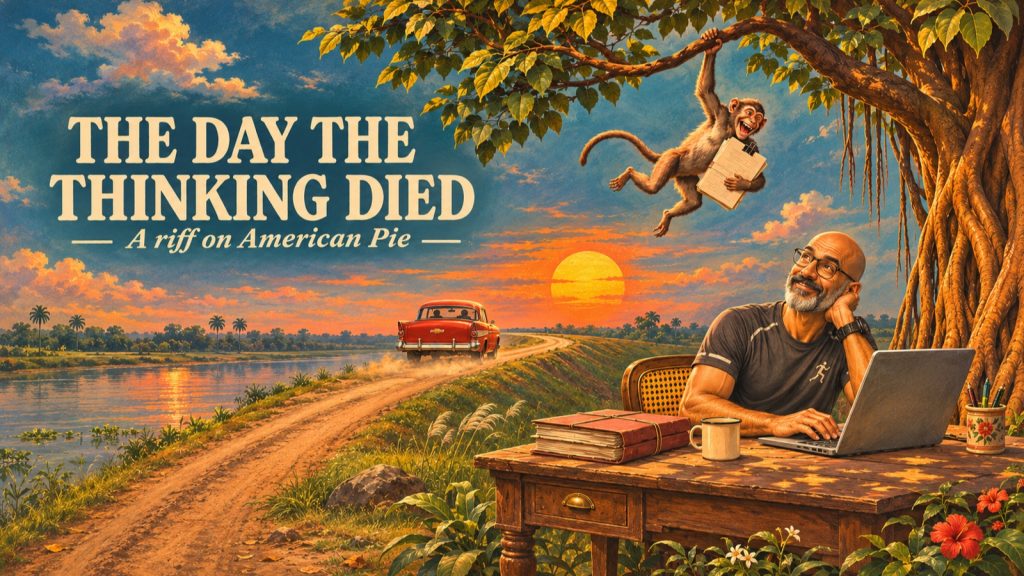
In the schoolbook version of evolution I remember, a monkey comes down from a tree, several million years pass, and eventually Bhaskar opens a laptop. Somewhere on that long walk we develop a considerable opinion of ourselves as a species, largely on account of our ability to think.
Now look at us. Evolution has come full circle. We’re ready to be monkeys again, jumping from tree to tree. The UTM tree gives us a word. The GST tree gives us six digits. The Claude tree gives us three paragraphs and an executive summary. At six o’clock I swing by on my way home, type “Looks good, send,” and complete another successful day in the knowledge business.
Then American Pie comes on. I know when to come in for the chorus. I’ve driven that Chevy to the levee with Don McLean for years. Ask me what a levee is and watch me reach for my phone.
Fair enough. At least I wanted to know. What bothers me is how often I get through a working day without once having that feeling.
If I can get all the way from the Chevy to the levee just by singing along, how would I know if I’d lost the ability to think for myself somewhere along the way?
