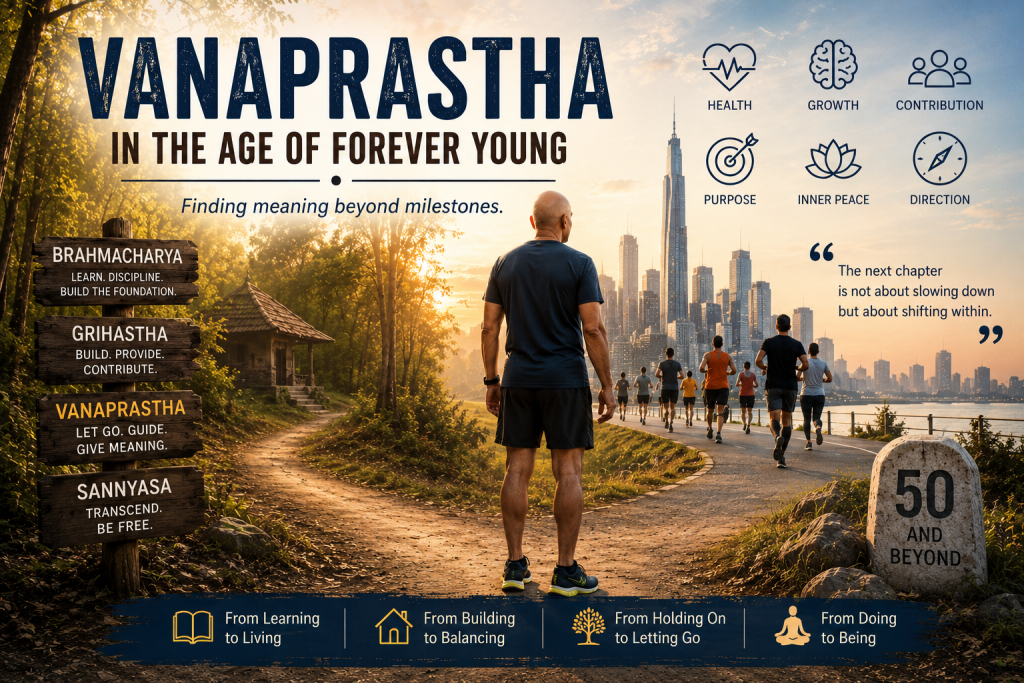
I understood Brahmacharya because my parents drew the boundaries. I entered Grihastha almost on autopilot. Now, at fifty, I am trying to understand Vanaprastha—but everyone around me appears determined to become thirty again.
There was a time when life came with reasonably clear instructions.
Study.
Find work.
Get married.
Build a home.
Raise a family.
Earn enough to stop worrying about money.
Then, at an appropriately respectable age, slow down.
The ancient Indian āśrama system gave this journey more philosophical names: Brahmacharya, Grihastha, Vanaprastha and Sannyasa.
They were not originally four equal, compulsory 25-year compartments, as popular WhatsApp philosophy often presents them. Historian of religion Patrick Olivelle argues that the earliest āśrama traditions described four legitimate ways of living—a student, a householder, a forest hermit and a renouncer. Only gradually did they become arranged into the familiar sequence of life stages. The early Gautama Dharmasūtra even says that a person who had completed Vedic study could choose among the different orders. (Internet Archive)
But whether they began as choices or stages, the framework contains a question that feels remarkably contemporary:
What should change within us as we grow older?
That question has become harder because, while human beings continue to age, modern culture has declared ageing optional.
Fifty is the new forty.
Forty is the new thirty.
Sixty is the new forty.
At this rate, by eighty we will all be applying for campus placements.
Nobody wants to miss the nectar of youth. We colour the hair, count the protein, measure heart-rate variability, replace knees, run marathons, track sleep and buy watches that congratulate us for standing up. Age is no longer something we inhabit. It has become a hostile takeover we must continuously resist.
I am part of this resistance movement.
I run marathons and ultramarathons. On my fiftieth birthday, I completed my fiftieth timed race—a 50-kilometre ultra—because apparently cutting a cake was not sufficiently complicated. I documented it in Kaas Ultra: 50 KM Race Review.
So this is not an argument for becoming old before one’s time.
It is an attempt to understand why growing older has become easier physically, yet more confusing philosophically.
Brahmacharya: When the guardrails were visible
My Brahmacharya was not particularly Vedic.
There was no forest gurukul. I did not sit beneath a tree absorbing the wisdom of a rishi. I was a boy from Jamshedpur being guided by that most powerful institution in Indian civilisation: middle-class parental anxiety.
The classical meaning of Brahmacharya was broader than celibacy. It referred to the disciplined life of a student—living with a teacher, learning, serving, practising restraint and preparing for responsibility. The Chāndogya Upaniṣad 2.23.1 refers to the brahmacharin residing in the teacher’s house as one of the recognised branches of dharmic life. (Wisdom Library)
My parents provided the restraint.
They supplied the direction, the boundaries and, when necessary, the banker’s cheque.
I supplied uncertainty.
As I wrote in ATKT: Allow To Keep Trying, my marks did not suggest an especially luminous academic future. Engineering colleges examined my performance and, in the larger national interest, kept me away from infrastructure.
I reached Pune at nineteen with poor marks, high hope and parental guardrails still operating remotely from Jamshedpur.
My education was less a pursuit of knowledge and more a prolonged border crossing. I was not trying to top the class. I was trying to remain legally present in the academic system.
But that, too, was Brahmacharya.
Not because I was disciplined, but because someone else was holding the discipline together until I could carry it myself.
Parents often perform this role without announcing it. They build a corridor through which a child can move safely while believing he is making independent choices.
At that age, freedom meant escaping the guardrails.
At fifty, one begins to see that the guardrails were often the reason the vehicle remained on the road.
Grihastha: Life on autopilot
Then came Grihastha.
The householder stage is sometimes presented as the ordinary, worldly interruption between two more spiritual stages. But classical texts give it enormous importance. The Gautama Dharmasūtra calls the householder the source or foundation of the other orders because the student, forest dweller and renouncer depend upon the food and resources generated by household life. (Wisdom Library)
Grihastha is where life becomes crowded.
Career.
Marriage.
Family.
Parents.
Clients.
Salaries.
Loans.
Taxes.
School calendars.
Hospital visits.
Social obligations.
Repair bills.
And the mysterious business invoice whose payment is always being processed “next week”.
I entered this stage almost on autopilot.
Not because nothing significant happened, but because everything happened at once. One responsibility arrived before the previous one could be understood. You moved from deadline to deadline, year to year, believing that clarity would appear after the next milestone.
After the degree, clarity would come.
After the MBA.
After the job.
After starting the business.
After reaching a certain turnover.
After saving a certain amount.
After running a certain marathon time.
The promised clarity behaved like a client payment: always approved, never credited.
In Chaube Gaye Chhabe Banne, Rahe Gaye Dube, I wrote about my habit of going out to become something larger and frequently returning smaller. I wanted marks at eighteen, a career at twenty-two, a company at thirty and wealth at forty.
At fifty, I want clarity.
Grihastha is supposed to teach contribution. But it can quietly become accumulation.
We accumulate roles, assets, obligations, contacts, medals, shoes, grudges and unread WhatsApp groups. We begin by building a life and eventually find ourselves operating it like an underfunded conglomerate.
The ancient system may have understood something we have forgotten: the skills needed to construct a life are not the same skills needed to release one.
Ambition builds.
Control maintains.
But neither knows when to leave the room.
Vanaprastha: The forest that no longer exists
Vanaprastha literally suggests setting out toward the forest.
Later Dharma texts describe the forest dweller simplifying food, possessions, clothing and comfort; practising austerity and reflection; and gradually withdrawing from the centre of household authority. Historically, however, the system evolved over time. Scholars note that early Vedic texts do not present a fully developed four-stage sequence, and early Dharmasūtras may have regarded these as alternative lifestyles before they became a chronological model. (Wikipedia)
The forest was therefore both a place and an idea.
It created distance.
Distance from daily transactions.
Distance from status.
Distance from the belief that the household would collapse without one’s supervision.
That last distance may have been the hardest.
The modern fifty-year-old, however, has no obvious forest to enter.
We have second careers, startups, marathons, dating apps, leadership summits, anti-ageing clinics and Instagram reels telling us that our best life is still buffering.
The people around me are not preparing for withdrawal.
They are growing younger.
Friends are running faster, lifting heavier, travelling further and dressing better. Some are rebuilding businesses. Some are rebuilding bodies. Some are rebuilding relationships. Everyone appears to have received an internal memo:
Under no circumstances surrender the nectar of youth.
Even retirement has been rebranded as reinvention.
There is much that is admirable here. Longer, healthier lives should expand possibility. Treating people as irrelevant merely because they have crossed fifty is ageism, not philosophy. The World Health Organization has warned that ageist attitudes are widespread and are associated with poorer health, isolation and reduced quality of life. (World Health Organization)
Vanaprastha should not become a religious excuse for pushing older people out of work, public life or pleasure.
But rejecting ageism is different from rejecting age.
The first says: Do not limit me because of my years.
The second says: My years must mean nothing.
That is where I feel the conflict.
I do not want to stop running. I do not want to stop working, writing, learning or building. I have already survived several technological migrations—from the analogue world to the internet, social media and now artificial intelligence—as I wrote in Forever Nomads: The 70s Kid—From Digital Migrants to AI Refugees.
I am willing to migrate again.
I am less certain about what I should leave behind.
Perhaps Vanaprastha is not about doing less
Maybe the modern misunderstanding is that Vanaprastha means retirement.
Perhaps it means changing one’s relationship with relevance.
In Grihastha, I wanted to be needed.
In Vanaprastha, perhaps I must learn to be useful without being central.
That is a difficult transition for founders, parents, professionals and amateur heroes.
We build our identities around solving problems. We become the person who knows, decides, signs, pays, advises, repairs and rescues. Then one day the next generation solves a problem without consulting us.
This should feel like success.
It often feels like redundancy.
The ancient forest may have offered a structured response. Step back voluntarily before life removes you involuntarily. Transfer authority before holding on to it becomes your principal occupation. Turn experience into guidance—but do not convert guidance into surveillance.
Vanaprastha may therefore be less about abandoning work and more about abandoning ownership of outcomes.
You can continue to build without needing your name on every wall.
You can advise without requiring obedience.
You can love your family without managing every decision.
You can run without every race becoming proof that age has not defeated you.
You can remain ambitious without treating every younger person as competition and every birthday as an accusation.
The body enters the forest before the mind
My body has occasionally tried to explain Vanaprastha to me.
The message has usually arrived through the knee or hamstring.
After an injury, I wrote Diary of a Rehab Bro with a Hustle Hangover. The strange thing about rehab is that the mind still remembers the athlete you were yesterday, while the body has already opened negotiations with tomorrow.
Recovery requires humility.
You cannot motivational-quote a tendon into healing.
You cannot pitch-deck inflammation.
The body introduces limits not necessarily to diminish life, but to change the way we inhabit it.
At twenty-five, pain is an interruption.
At fifty, it becomes correspondence.
The temptation is to fight every signal as evidence of decline. But perhaps Vanaprastha asks for a different intelligence: not surrender, but listening.
Run—but recover.
Work—but release.
Compete—but choose the race.
Stay strong—but stop pretending strength has only one form.
I am not ready for Sannyasa
Let me be clear.
I am not heading for Sannyasa.
I still have desires.
Some are noble.
Some involve marathon timings.
Some involve business.
Several involve panipuri.
I remain attached to family, work, running shoes, stories, spreadsheets and the possibility that the next idea may finally prove I was a visionary and not simply an optimistic side character.
But perhaps one does not need to complete Vanaprastha before beginning it.
The transition may start with smaller withdrawals:
From the need to win every argument.
From the need to attend every gathering.
From the need to remain the hero in every story.
From the need to turn health into youth, wealth into status and busyness into purpose.
From the belief that slowing down in one area means giving up on life.
The forest can begin as an empty hour.
A walk without a performance metric.
A conversation in which one does not offer advice.
A business decision delegated without secretly rewriting it later.
A race run for experience rather than validation.
A day in which nothing is posted.
The new meaning of fifty
Fifty does not have to be the new thirty.
Thirty was already thirty. I lived it once. It had energy, ambition and better recovery, but it also had confusion, insecurity and terrible financial decisions.
I do not need it again.
Perhaps fifty should be allowed to become fifty.
Not old.
Not young.
Not retired.
Not desperately relevant.
Just a distinct stage with its own work.
The work of separating ambition from anxiety.
The work of converting experience into perspective.
The work of helping without controlling.
The work of enjoying the nectar of life without insisting that it must always taste like youth.
My Brahmacharya had parental guardrails.
My Grihastha ran largely on responsibility and autopilot.
My Vanaprastha has no forest, no manual and no clearly marked entrance.
Perhaps that is why I am writing it into existence.
I may continue working.
I will certainly continue running.
I will probably continue giving advice even when no one has asked for it.
But somewhere between the boardroom, the running track and the panipuri stall, I hope to learn the central discipline of Vanaprastha:
To remain fully alive without needing to remain permanently young.
And, more difficult still:
To stay in the world—without always needing the world to revolve around me.
References and further reading
- Patrick Olivelle, The Āśrama System: The History and Hermeneutics of a Religious Institution, Oxford University Press, 1993.
- Chāndogya Upaniṣad 2.23.1, on study, charity, austerity and the life of the brahmacharin. (Wisdom Library)
- Gautama Dharmasūtra, Chapter III, on the student, householder, ascetic and forest hermit, and the householder’s supporting role. (Wisdom Library)
- World Health Organization, Global Report on Ageism and accompanying UN/WHO findings. (World Health Organization)

Excellent Bhaskar. Almost a similar story I wanted to tell but never had any words or skills to describe.
“To remain fully alive without needing to remain permanently young.!!!! AGREE on this 💯”
Honestly Vaanaprastha personally is liberating for me indeed! The focus moves from being the centre to just being in acceptance, awareness and in silence ( beyond body mind and intellect) – TRUE FREEDOM personally and I am happy to be here now.
Agree just like you ( I am not ready for Sanyaasa yet as I relish icecreams , chocolates, travels, meeting new people, conversations over coffee and running – trekking in Himalayas etc) – who says Sanyaasa is giving up everything??! 😃I’d redefine it as living life 100% without the strong attachment to these things or intense desire- its a FLOW state where one just sails along joyfully – when that happens I will fall into it without even realizing it perhaps just like Vaanaprastha!
Enjoyed reading every bit BT – keep writing
Pranam
🙏🏼😊
The conversations(or struggles😃) between mind and body with each passing year(or decade) is clearly depicted here. Loved reading it BT.
Absolutely love the flow of your writing, the depth, your wry humour and puns. Very well researched and referenced.
I believe most of us do get to Vanaprastha organically and quietly. It’s just that the folks trying to beat it all are just a tad better at self branding and marketing – so much “in your face” online content bogging us down for no good reason !!
Thanks Bhaskar for sharing this very enlightening post.