There was a time in India when Cash was King.
Not metaphorically.
Actual King.
He lived in a brown leather wallet, travelled folded inside your pocket and occasionally emerged smelling of sweat, petrol and paan.
You bought samosa — cash.
Pooja ke phool — cash.
Auto — cash.
Driver salary — cash.
House-help salary — cash.
Plumber — cash.
Electrician — cash.
And if your mother gave you ₹500 to buy something worth ₹380, there was a full statutory audit when you returned home.
“Baaki ₹120?”
No OTP.
No transaction ID.
No screenshot.
Just RBI Governor: Mummy.
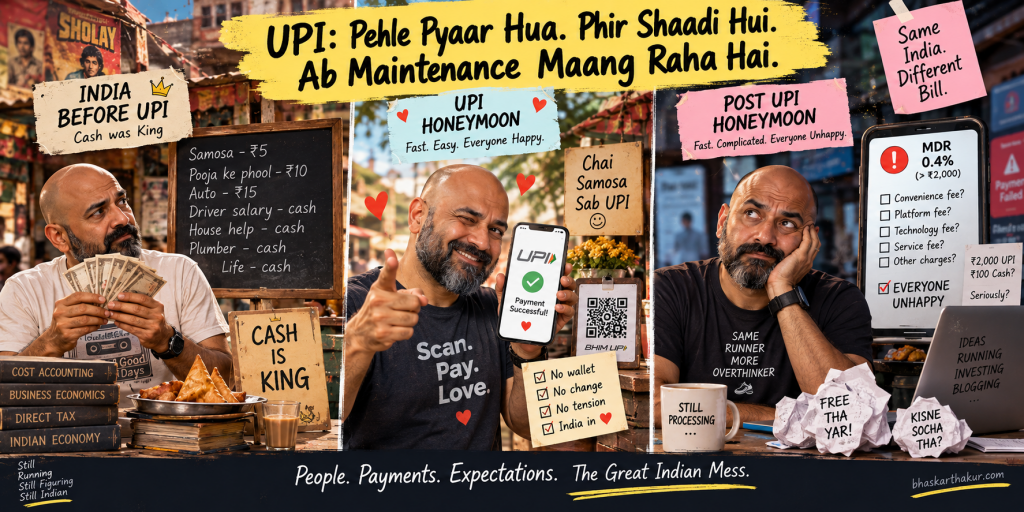
Act 1: India Before UPI
Cash had one fantastic feature.
₹100 left your hand.
₹100 reached the other hand.
The samosawala didn’t receive ₹98.50.
The electrician didn’t say:
“Sir, settlement T+1 mein hoga.”
Nobody asked your Merchant Category Code before selling you dhaniya.
Money travelled downline and upline in the economy.
Customer paid shopkeeper.
Shopkeeper paid distributor.
Distributor paid wholesaler.
Wholesaler paid manufacturer.
Everybody got money.
Real money.
Occasionally slightly oily money.
But money.
Then there were credit cards.
Credit cards were a completely different romance.
You could buy something today using money that Future You would somehow arrange.
Future You was a very optimistic fellow.
Banks encouraged this optimism.
“Congratulations! Your credit limit has been enhanced.”
Nobody had asked.
But thank you.
You bought televisions, refrigerators, flight tickets, hotel rooms and things that suddenly became “affordable” because they were divided into 12 emotionally manageable pieces.
And there was a beautiful economic arrangement behind it.
The consumer got credit.
The consumer got reward points.
The reward points became airline miles.
The airline miles convinced the consumer that the ₹18,000 hotel room was actually free.
The merchant paid MDR.
Standard credit-card MDR today is typically around 1.5%–2.5%. (Moneycontrol)
That was understood as the cost of accepting a payment method that brought customers with purchasing power.
And if the consumer didn’t pay the credit-card bill?
Then the bank introduced him to another beautiful Indian financial tradition:
3%–3.5% per month type finance charges.
Roughly 36%–42% a year before we even start discussing how compounding and other charges make the experience more educational. RBI requires issuers to disclose their rates and calculation methodology rather than prescribing one universal credit-card rate. (System Health)
Consumer got convenience.
Merchant got business.
Bank got MDR and interest.
Card network got its cut.
Airline got a passenger who proudly announced:
“Ticket toh points pe hai.”
Everyone was happy.
Or at least everyone understood who was paying whom.
Act 2: Then UPI Entered Our Lives
And then came UPI.
UPI was not a payment system.
UPI was the new girlfriend.
Or boyfriend.
Or partner.
Or, to remain 2026-compliant:
UPI was THE ONE.
It was beautiful.
It was fast.
It didn’t ask for your wallet.
It didn’t ask whether you had change.
It didn’t ask whether the POS machine was working.
It just said:
Scan me.
India fell in love.
The samosawala put up a QR code.
The phoolwala put up a QR code.
The chaiwala put up a QR code.
The coconut seller put up a QR code.
The plumber had a QR code.
The auto driver had three QR codes.
One belonged to him.
One to his wife.
And one, for reasons that were never adequately explained, to someone called Pintu Kumar.
We didn’t care.
“Bhaiya, ho gaya.”
“Ting ting.”
Love.
By August 2026, UPI was processing about 24.5 billion transactions in a single month, worth roughly ₹29.82 lakh crore. (NPCI)
Twenty-four-and-a-half billion.
We Indians had essentially converted:
“Chhutta nahi hai.”
into a national technology mission.
And UPI had one killer feature.
Zero MDR.
For years, merchants essentially received the full bank-account-funded UPI payment without the MDR that accompanied cards.
This was extraordinary.
The consumer paid nothing.
The merchant paid nothing.
And somewhere behind the scenes banks, fintechs, payment apps, servers, cybersecurity teams and infrastructure were processing billions of transactions.
The government even supported low-value merchant transactions through incentives. For FY2024-25, for example, it approved a ₹1,500 crore scheme, including a 0.15% incentive on eligible UPI transactions up to ₹2,000 to small merchants. (Press Information Bureau)
Basically:
Customer: I won’t pay.
Merchant: I won’t pay.
Bank: …
Fintech: …
Server: …
Government: Accha, dekhte hain.
But who cared?
We were in the honeymoon phase.
And during honeymoon nobody discusses maintenance.
Act 3: Honeymoon Khatam
September 2026.
UPI grew up.
From 15 October 2026, eligible person-to-merchant UPI payments above ₹2,000 will attract an MDR of 0.4%.
Payments up to ₹2,000 remain free.
Person-to-person payments remain free.
Small merchants receiving up to ₹1 lakh per month through qualifying UPI QR transactions remain protected under zero MDR.
Transactions of ₹75,000 and above have the MDR capped at ₹300.
Essential sectors such as railways, telecom, insurance, fuel and agricultural inputs get a flat ₹5 MDR above ₹2,000.
And capital-market transactions get a separate 0.02% rate, capped at ₹300. (Press Information Bureau)
The government also says customers aren’t supposed to pay this MDR. It is a merchant-side ecosystem charge, and roughly 96% of merchant transactions are expected to remain unaffected. (Press Information Bureau)
Which sounds entirely reasonable.
Until Indians start doing Indian things.
Because now imagine this conversation.
Bill: ₹2,100.
Customer:
“UPI?”
Merchant:
“Cash hai?”
Customer:
“UPI hai.”
Merchant:
“₹2,000 UPI kar do. ₹100 cash.”
And suddenly India has invented hybrid payments.
Digital India powered by one QR code and one Gandhi note.
And Here Is Where It Gets Interesting
For a ₹10,000 eligible UPI merchant transaction:
UPI MDR: ₹40
At a typical credit-card MDR of 1.5%–2.5%:
₹150–₹250
So UPI is still dramatically cheaper than credit cards. (Business Standard)
At ₹1 lakh, because of the UPI cap:
UPI MDR: ₹300
Credit card at 1.5%–2.5%:
₹1,500–₹2,500. (Business Standard)
Economically, UPI hasn’t suddenly become expensive.
But psychologically?
Arre! Kal tak free tha!
And nothing hurts an Indian consumer or businessman more than paying ₹10 for something that was ₹100 yesterday.
Except paying ₹1 for something that was free yesterday.
Now Everyone Is Unhappy
The consumer says:
“Why should digital payments become expensive?”
Technically, they haven’t become expensive for him. The MDR isn’t supposed to be charged to the customer. (Press Information Bureau)
But the consumer has lived in India long enough to know that costs have an extraordinary ability to reincarnate.
Not as “MDR.”
Never.
They return as:
Convenience fee.
Handling fee.
Platform fee.
Technology fee.
Service fee.
Or my personal favourite:
Other Charges.
The merchant says:
“Why should I pay for receiving my own money?”
Fair question.
The bank says:
“Who will pay for the infrastructure?”
Also fair question.
The fintech says:
“We built the app you use 17 times before lunch.”
Fair.
The government says:
“Most transactions are still free.”
Also correct.
So everybody is technically right.
Which is usually the starting point of a proper Indian mess.
Meanwhile, Credit Card Is Sitting Quietly in the Corner
This is my favourite character in the story.
Credit Card Uncle.
For decades he openly said:
“Main merchant se MDR lunga.”
Fine.
“Customer ko points dunga.”
Fine.
“Customer bill nahi bharega toh uski financial kundli badal dunga.”
Also fine.
Everyone knew the rules.
Credit card was that expensive restaurant where the menu clearly tells you the dal costs ₹750.
You may complain.
But you ordered it.
UPI was the neighbourhood aunty feeding you dal for free for six years.
Now she has said:
“Beta, ₹20 de dena.”
And the entire mohalla has called a press conference.
The Real UPI Mess
UPI’s problem isn’t 0.4%.
Its problem is expectation.
We created perhaps the world’s most successful digital-payment habit by removing the most visible price from the system.
It worked spectacularly.
UPI now processes tens of billions of transactions every month. (NPCI)
The phoolwala accepts it.
The chaiwala accepts it.
The housing society accepts it.
The hospital accepts it.
The luxury store accepts it.
We don’t say:
“Do you take UPI?”
We say:
“QR kidhar hai?”
That is an incredible behavioural change.
But somewhere during the honeymoon, we started believing that because we weren’t paying for UPI, UPI cost nothing to run.
Those are two very different things.
And That Brings Us Back to Cash
Cash is sitting quietly in the drawer.
Old.
Wrinkled.
Ignored.
Like Amitabh Bachchan watching the new heroes dance.
Cash doesn’t have reward points.
Cash doesn’t have cashback.
Cash doesn’t have transaction history.
Cash doesn’t send you:
₹450 debited successfully.
Cash just moves.
₹500 leaves one pocket.
₹500 reaches another pocket.
No server.
No MDR.
No payment gateway.
No “transaction pending.”
No SMS arriving four hours later.
And definitely no debate on LinkedIn about payment-system sustainability.
Cash looks at UPI.
UPI looks at Credit Card.
Credit Card looks at the bank.
Bank looks at the merchant.
Merchant looks at the customer.
Customer looks at the QR code.
And everybody asks the most Indian economic question ever:
“Paise kaun dega?”
That is where the UPI honeymoon officially ends.
Not because 0.4% is unreasonable.
Not because UPI has failed.
Quite the opposite.
UPI has become so successful that we now have to answer the question every successful business eventually faces:
Who pays for the success?
Before UPI, everyone knew.
After UPI, nobody wanted to know.
And now that somebody has finally asked—
Everyone is unhappy.
Except Cash.
Cash is sitting in the corner, smiling.
“Main toh pehle hi bola tha.Mere mein network problem nahi hai.”

Everything you never knew you needed to know about UPI, documented with more enthusiasm than your average RBI circular. Genuinely a fun read. This blog does for UPI what a good detective show does for crime — breaks down the whole system so clearly, you start explaining IMPS vs UPI to strangers at parties, means Insta bloggers to the WW followers :))